


 904-822-1078

How Much Do Large Bi-Fold & Folding Glass Doors Cost? A 2026 Pricing Guide for Commercial Projects
Commercial folding glass door systems in 2026 typically range from $1,200 to $3,000+ per linear foot installed, depending on frame material, glass spec, panel count, configuration, and whether you're buying factory-direct or through a dealer distribution chain. A full restaurant or hospitality opening — say, a 24-foot folding glass wall — can land anywhere from $28,000 to $72,000 or more. This guide breaks down every major cost driver so contractors, builders, developers, and dealers can budget accurately and source smarter.
By the Gladiator Window & Doors editorial team — written with input from our in-house project engineers and commercial sales desk in Jacksonville, FL.
1. How Much Does a Folding Glass Door System Cost for a Commercial Opening?
For a commercial-grade thermal-break aluminum folding glass door system, budget $18,000–$65,000+ for the door unit alone (before installation labor) on a typical restaurant, retail, or hospitality opening between 16 and 32 feet wide. Here's what drives that range:
- Frame specification: Thermally broken aluminum profiles add cost over non-thermally-broken extrusions, but are required for most commercial energy codes and California Title 24 compliance. Gladiator systems ship standard with thermal-break aluminum frames.
- Glass package: Gladiator's standard is 6mm tempered or dual-pane insulated glass. Dual-pane low-e IGU units with documented NFRC U-factors and SHGC ratings add roughly 15–25% to glass cost vs. single-pane, but are necessary for most commercial projects seeking energy compliance.
- Panel count and total width: More panels = more hardware, more glass, more extrusion. A 6-panel system at 24 ft costs significantly more than a 4-panel at 16 ft.
- Sill and track spec: Low-profile flush sill tracks for ADA-path compliance are standard on Gladiator systems; recessed or thermally broken threshold upgrades can add $200–$600 to a project.
- Finish: Matte black, dark grey RAL 7016, white RAL 9010, and bronze anodized are standard Gladiator finishes. Custom powder-coat colors on commercial orders carry an upcharge of 8–15%.
Rough budgeting baseline for Gladiator factory-direct commercial bi-fold systems (unit cost, pre-installation):
| System Width | Typical Panel Count | Gladiator Factory-Direct Unit Range | Dealer/Distributor Unit Range (est.) |
|---|---|---|---|
| 12 ft | 3–4 panels | $9,500–$15,000 | $13,000–$20,000+ |
| 16 ft | 4 panels | $13,000–$19,000 | $18,000–$26,000+ |
| 20 ft | 5 panels | $17,500–$25,000 | $24,000–$34,000+ |
| 24 ft | 6 panels | $22,000–$32,000 | $30,000–$44,000+ |
| 32 ft | 8 panels | $29,000–$44,000 | $40,000–$60,000+ |
Ranges reflect standard dual-pane low-e glass, thermal-break aluminum, matte black or standard color finish. Custom sizes, higher-spec glass packages, or specialty finishes will adjust pricing. Contact our commercial sales desk for a project-specific quote.
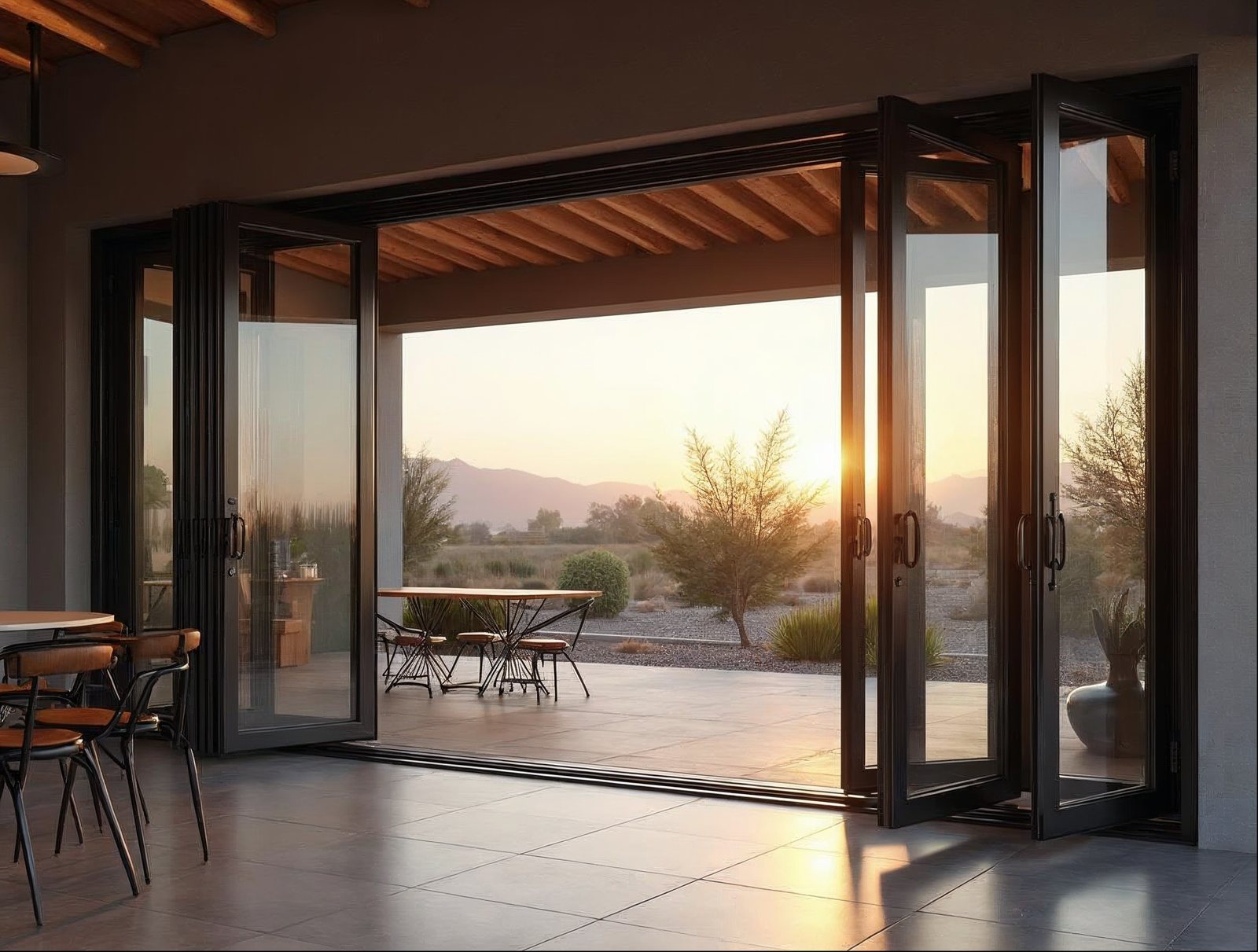
2. What Do Large Bi-Fold Patio Doors Cost Per Panel or Per Linear Foot?
On a per-panel basis, commercial-grade aluminum bi-fold door panels from a factory-direct source typically cost $2,800–$5,500 per panel for thermally broken aluminum with dual-pane low-e glass; on a per-linear-foot basis, expect $950–$1,800 per linear foot for the door unit only.
Here's why those numbers vary so widely:
- Panel width: Gladiator bi-fold panels can be configured in widths from approximately 24 inches to 36 inches per leaf. Wider panels use more glass and more extrusion per panel. A narrow 24-inch panel in an 8-panel run will cost less per panel than a 36-inch panel in a 4-panel run, even at the same total opening width.
- Panel height: Standard heights up to 9 ft 10 in are common in stock and made-to-order configurations. Taller panels — 10 ft, 11 ft, 12 ft — require heavier-gauge extrusion and larger glass lites, pushing per-panel cost up 20–40%.
- Glass specification: 6mm tempered single pane, dual-pane clear, or dual-pane low-e with documented U-factor and SHGC each carry different price points. Gladiator's standard 6mm glass spec is a meaningful differentiator — thinner glass in budget systems deflects more and seals less effectively at large panel sizes.
- Stack configuration: Panels that stack all to one side (vs. splitting to both sides) affect frame count and hinge hardware requirements, which slightly impacts total system cost.
- In-stock vs. made-to-order: Gladiator maintains in-stock doors ready to ship in the most popular configurations. Standard sizes ship faster and avoid the lead-time premium of fully custom fabrication.
For contractors pricing a restaurant patio enclosure or a residential developer spec-ing a luxury spec home, the per-linear-foot metric is usually the most reliable for early-stage budget modeling. Use $1,200–$1,500/LF as a mid-market planning figure for Gladiator factory-direct thermal-break aluminum with dual-pane low-e glass.
3. How Much Are Folding Glass Walls for Commercial or Restaurant Projects?
Full folding glass wall systems for commercial, hospitality, and restaurant applications — where the entire face of a building opens — cost $28,000–$90,000+ as an installed system, accounting for the door unit, framing/header prep, track installation, and labor. The wide range reflects the diversity of openings in commercial work.
Key variables specific to restaurant and commercial projects:
- Structural header requirements: Wide folding glass wall openings — 20 ft, 24 ft, 32 ft or more — require engineered steel or LVL headers sized by the project's structural engineer of record. This is a significant construction cost separate from the door unit itself. Budget $3,000–$12,000+ for header fabrication and installation on large commercial spans, depending on structural conditions.
- Rough opening and jamb tolerances: Gladiator systems require a plumb, level, and square rough opening within ¼ inch tolerance. On commercial projects with CMU or tilt-up construction, shimming and grouting the sill is common and adds to installation labor.
- Multi-run configurations: Many restaurants spec folding glass walls on two or three faces of a space. Each run is priced separately, but multi-run orders often qualify for volume trade pricing through the Gladiator wholesale program.
- California Title 24 compliance: Projects in California must document fenestration U-factor and SHGC. Gladiator provides whole-door NFRC documentation on request for commercial projects requiring energy compliance submittals.
- Lead times: Made-to-order commercial systems typically ship in 6–10 weeks from confirmed order. In-stock standard configurations can ship in days. Plan fabrication lead time into your construction schedule before permit submission.
Restaurant operators and hospitality developers should request a line-item quote that separates the door unit cost, threshold/sill upgrades, and any engineer-stamped shop drawings required for permit, so each cost center is visible in the project pro forma.
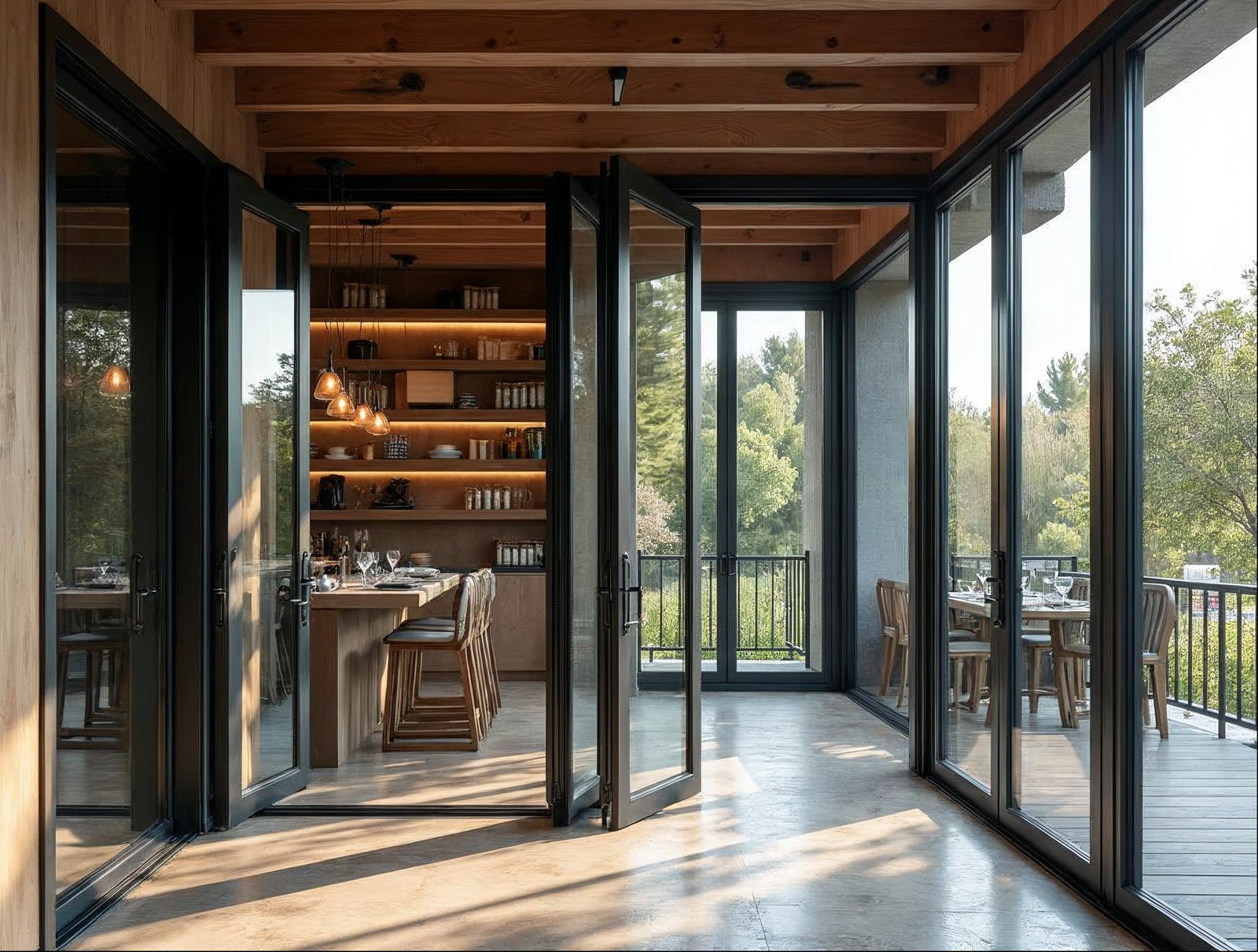
4. What Factors Drive the Price of Exterior Folding Glass Doors Up or Down?
The single biggest cost driver for exterior folding glass doors is panel count × panel size × glass specification — everything else is secondary. Here's a ranked breakdown of what moves the needle most:
Cost Drivers That Increase Price
- Greater total width or height — More glass, more extrusion, more hardware.
- Higher glass specification — Upgrading from 6mm tempered single to dual-pane low-e IGU with documented NFRC performance is the largest single line-item variable on the glass side.
- Custom colors or finishes — Standard Gladiator finishes (matte black, RAL 7016, RAL 9010, bronze anodized) carry no upcharge. Bespoke powder-coat adds 8–15%.
- Non-standard panel widths or heights — Made-to-order fabrication outside standard size ranges adds cost and lead time vs. in-stock configurations.
- Multi-point locking hardware upgrades — Commercial multi-point locking bars, flush bolts, or keyed cylinder options carry hardware upcharges.
- Buying through a dealer or distributor — Dealer markup, rep commission, and regional distribution overhead typically add 30–50% to the net manufacturer price. More on this below.
Cost Drivers That Reduce Price (or Preserve Budget)
- Ordering standard in-stock sizes — Gladiator's stocked configurations skip fabrication queue entirely.
- Factory-direct purchasing — No distributor margin, no dealer commission, no showroom overhead.
- Volume orders across a project or development — Multi-unit residential developments, hotel renovations, and restaurant chains ordering across multiple locations qualify for enhanced trade pricing through Gladiator's wholesale program.
- Accurate rough-opening prep before delivery — Rework caused by out-of-square openings is the #1 field cost overrun on bi-fold door installations. Getting the RO right the first time saves a day or more of labor.
- Early specification — Specifying Gladiator systems at design development (not during construction documents) allows the project to lock pricing and lead time, avoiding schedule-driven expedite fees.
Comparison: Gladiator vs. Common Folding Door System Archetypes
| Feature / Spec | Gladiator Aluminum (Factory-Direct) | Traditional Top-Hung Folding Systems | Wood-Clad Folding Door Systems |
|---|---|---|---|
| Frame material | Thermal-break aluminum | Aluminum (thermal break varies) | Wood interior / aluminum or clad exterior |
| Standard glass thickness | 6mm tempered standard | Varies; often thinner on budget lines | Typically dual-pane; glass spec varies |
| NFRC whole-door U-factor | Documented on request | Varies by manufacturer | Available; wood frame affects performance |
| Sill track profile | Low-profile flush track standard | Varies; some raised sills | Often raised wood sill |
| Typical factory-direct unit cost (24 ft, 6-panel) | $22,000–$32,000 | Not applicable (dealer-sold only) | Not applicable (dealer-sold only) |
| Typical dealer-channel unit cost (same config) | N/A — sold direct | $30,000–$48,000 (est. dealer price) | $38,000–$65,000+ (est. dealer price) |
| Lead time (standard config) | In-stock: ships in days; made-to-order: 6–10 wks | Typically 10–16 weeks via dealer | 12–20 weeks; wood sourcing dependent |
| Warranty | 15-year manufacturer warranty | Varies; confirm with dealer | Varies; wood components often shorter |
| Shipping | Free nationwide to all 50 states | Freight charges apply (dealer dependent) | Freight charges apply (dealer dependent) |
| Finish options | 4 standard; custom powder-coat available | Varies by brand | Paint-grade or stain-grade wood interior |
5. How Does Factory-Direct Pricing Compare to Buying Through a Dealer or Distributor?
Factory-direct purchasing eliminates 30–50% of the typical dealer and distributor margin that inflates the final price of folding glass door systems — meaning contractors and developers who buy direct pay for the product, not for the distribution chain. This is the core value proposition of the Gladiator model.
Here's how the two purchasing paths compare in practice:
Dealer/Distributor Channel
- Manufacturer sells to regional distributor at net price → distributor marks up 15–25% → dealer marks up another 20–35% → you pay retail or "contractor" price that still includes all of that overhead.
- Lead times accumulate at each node: factory fabrication + distributor staging + dealer order processing can mean 14–20+ weeks to your jobsite.
- Technical support routes through the dealer, who may or may not have direct access to factory engineers when issues arise.
- Freight is typically quoted separately and adds cost; multi-location project coordination is complicated by regional distributor territory boundaries.
Gladiator Factory-Direct Model
- You order directly from the manufacturer — no distributor, no showroom, no rep commission. The margin that would fund those layers stays in your project budget or your resale margin.
- In-stock configurations ship in days. Made-to-order systems ship in 6–10 weeks from our Jacksonville facility.
- Free freight to all 50 states is included. No surprise freight invoices on a large commercial order.
- Direct access to our commercial project team for rough-opening guidance, header planning, NFRC documentation, and field support.
- Trade and wholesale accounts get tiered pricing, priority production scheduling, and dedicated account management. The Reseller & Wholesale Application takes minutes to complete and opens access to trade pricing on every product line — bi-fold doors, sliding glass doors, pivot doors, and folding passthrough windows.
For a contractor running 10–20 door openings per year, the delta between dealer channel pricing and Gladiator factory-direct trade pricing represents a meaningful improvement in either project margin or competitive bid positioning. For a developer building a 50-unit project or a restaurant group rolling out multiple locations, the savings scale dramatically.
What the Wholesale Program Looks Like in Practice
- Apply online via the Reseller & Wholesale Application — approval is typically fast.
- Get a dedicated account rep who knows your project pipeline and can quote accurately in 24–48 hours on standard configurations.
- Order in-stock or made-to-order with confirmed lead times upfront — no surprises in your construction schedule.
- Receive freight-included delivery to your jobsite or staging facility anywhere in the United States.
- Backed by a 15-year warranty you can pass through to your clients as a project differentiator.
Sell Gladiator doors at a wholesale price. Factory-direct aluminum sliding, bi-fold, and pivot doors — premium aluminum, 6mm glass, low-profile tracks, no upcharges, shipped nationwide. Contractors, builders, designers, and retailers get trade pricing and real support.
Apply for a Reseller & Wholesale Account · Call 904-822-1078


