


 904-822-1078

Are Pocket Sliding Doors More Expensive Than Standard Sliding Glass Doors?
Yes — exterior pocket sliding glass doors typically cost more than conventional sliding patio doors because of the additional framing and wall pocket required to fully conceal the panels. A standard two-panel sliding glass door sits in a fixed frame with one stationary panel; a pocket-style multi-slide system disappears entirely into the wall cavity, demanding more precise rough-opening preparation, deeper framing, and a concealed track system. That engineering adds cost at every stage: the door unit itself, the structural wall work, and the installation labor.
As a rough benchmark for 2026, a quality exterior pocket sliding glass door system — including the door unit only, before installation — generally starts in the $3,500–$6,000 range for smaller openings (around 8–12 ft wide) and can rise to $10,000–$20,000+ for wide-span, multi-panel systems in custom sizes. Standard two-panel sliders covering a similar opening typically start lower, often in the $1,800–$4,000 range for the unit alone. The gap widens with panel count, glass upgrades, and opening width.
What Factors Drive the Price of Exterior Pocket Sliding Glass Doors Up or Down?
Six variables do most of the work when it comes to pocket sliding glass door pricing — controlling them is the fastest way to manage your budget.
- Opening width and panel count: Wider openings require more panels and more linear feet of track, frame, and glass. A 3-panel 12-ft system costs considerably less than a 6-panel 24-ft system.
- Glass specification: Standard 6 mm tempered clear glass is included in base pricing. Upgrading to low-E coatings, tinted glass, laminated lites, or triple-pane insulated units raises the unit price — sometimes significantly. Low-E glass is worth the investment in climates where California Title 24 energy compliance or simply lower utility bills are a priority.
- Thermal-break aluminum framing: A thermally broken aluminum frame (which breaks the conductive metal path between interior and exterior) improves energy performance and is standard on premium systems like Gladiator's. Thin-frame or non-thermal-break aluminum costs less upfront but underperforms on U-factor ratings over time.
- Track height (low-profile vs. raised): A flush, low-profile sill track is preferred for accessibility and aesthetics but requires a more precise floor-level installation detail. Raised-track systems are simpler to install but add a trip hazard.
- Hardware and finish: Matte black, dark grey RAL 7016, white RAL 9010, and bronze anodized finishes are all available. Specialty hardware — multi-point locking, recessed pulls, flush handles — adds to the unit cost.
- Standard vs. custom size: This is the biggest lever most buyers overlook. Standard dimensions kept in stock ship faster and cost less than made-to-order custom sizes. See the section below for details.
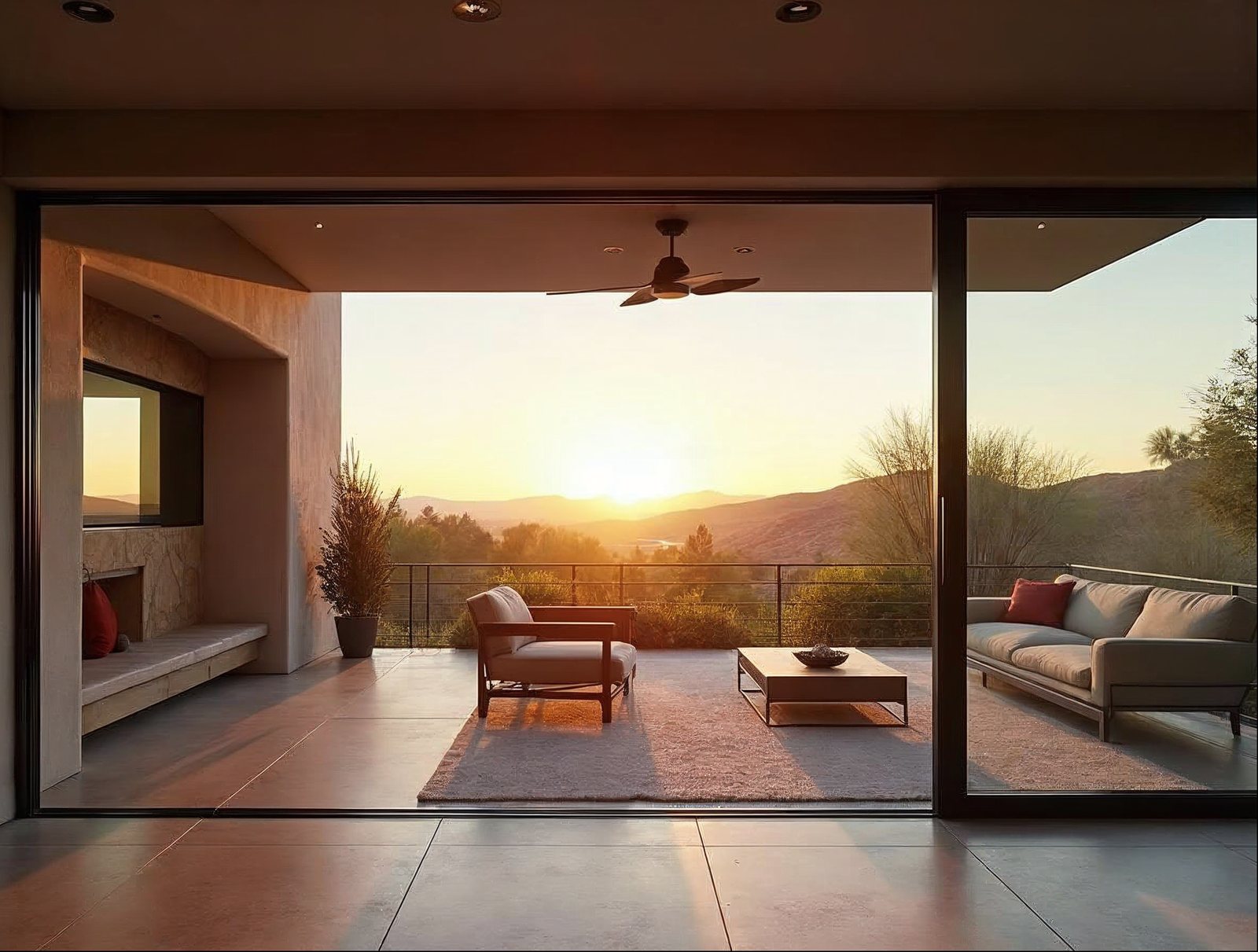
How Do Pocket Sliding Patio Door Prices Compare to Bi-Fold or Accordion Doors?
For equivalent opening widths, pocket sliding glass doors and bi-fold (accordion) doors land in a similar overall price range — but they serve different design goals, and the cost breakdown differs.
| System Type | Typical Unit Price Range (2026) | Wall Pocket Required? | Full Opening Achieved? |
|---|---|---|---|
| Pocket Multi-Slide | $3,500 – $20,000+ | Yes — adds framing cost | Yes — panels disappear into wall |
| Bi-Fold / Accordion Doors | $3,200 – $18,000+ | No — panels fold and stack | Yes — panels fold to one or both sides |
| Standard Multi-Slide (non-pocket) | $2,500 – $12,000+ | No — panels stack at jamb | Partial — stack takes some wall space |
The practical difference: a pocket slider hides its panels inside the wall cavity for a truly uninterrupted glass-to-glass view. A bi-fold door system achieves a nearly full opening by folding panels accordion-style against the jamb — no wall pocket needed, which keeps structural costs down. If your wall construction doesn't allow a pocket, bi-fold is often the better value path to a large open patio connection.
Both systems use thermal-break aluminum framing and 6 mm tempered glass on Gladiator's platform, so the energy performance and durability are comparable. The choice usually comes down to architecture: clean flat walls favor pocket sliders; tighter spaces or retrofit projects often favor bi-folds.
What Should Homeowners Budget for Pocket Sliding Glass Door Installation Labor?
Installation labor for an exterior pocket sliding glass door is typically the largest variable cost after the unit itself — plan for $1,500 to $5,000+ depending on your region, the scope of wall work, and whether a wall pocket must be framed from scratch.
Here is how labor breaks down:
- Basic installation (pocket already framed): If the rough opening and wall pocket are already prepared, a skilled installer or contractor can typically set a pocket slider in one to two days. Labor in this scenario runs roughly $1,500–$2,500 in most U.S. markets.
- Wall pocket framing (new construction or retrofit): Creating a wall pocket in an existing exterior wall means opening drywall, relocating insulation, possibly moving electrical or plumbing, and adding structural headers. This can add $1,500–$3,000 or more to the total labor bill and may require a structural engineer sign-off in some jurisdictions.
- Floor-level work for flush sill: Achieving a true flush threshold often requires cutting into the subfloor or slab to recess the track. Budget $500–$1,500 for this detail if you want a barrier-free sill.
- Regional variation: Labor costs in California, the Pacific Northwest, and major metro markets (New York, Chicago, Denver) tend to run 20–40% higher than the national median. Always get at least two bids from contractors experienced specifically with large aluminum door systems.
Pro tip: Ask your contractor whether they have installed aluminum multi-slide or pocket systems before — the track alignment tolerance is tighter than on a wood or vinyl door, and an inexperienced installer can create costly callbacks.
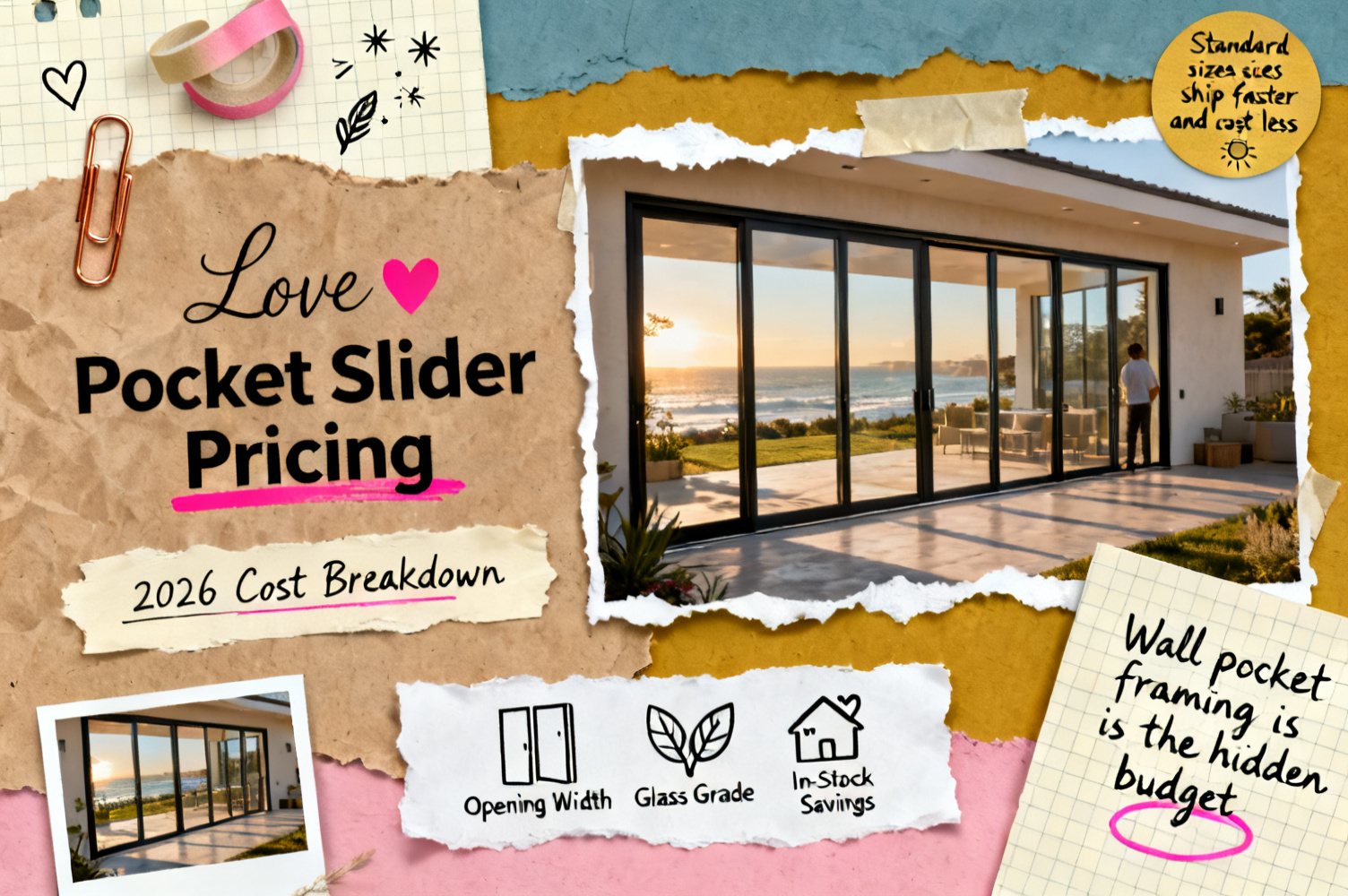
Are There In-Stock Pocket Sliding Glass Doors That Cost Less Than Custom Sizes?
Yes — choosing a standard size from Gladiator's in-stock inventory is the single most effective way to reduce both unit cost and lead time on a pocket sliding glass door project.
Made-to-order custom dimensions require additional production time and often carry a premium over catalog sizes. Standard Gladiator sliding door sizes are kept in stock in our warehouses and ship significantly faster than custom-built units — no waiting weeks for a production slot. If your rough opening can be framed to match a standard size (always the preferred approach in new construction), you get a better price and a faster project timeline.
Browse doors ready to ship now to see current standard sliding door dimensions and available finishes. For retrofit projects where the rough opening is already set, check the in-stock dimensions first before assuming you need a custom order — you may be closer to a standard size than you think.
Builders and contractors working on multiple units or repeat projects can also explore our reseller and wholesale program for volume pricing on standard sizes.
Is a Pocket Sliding Glass Door Worth the Extra Cost for a Large Patio Opening?
For large patio openings of 16 feet or wider, a pocket sliding glass door is almost always worth the investment — provided the wall construction allows for it. The core value proposition is unobstructed sightlines: when every panel disappears into the wall, there is no stack, no visible frame cluster, and no visual interruption between interior and exterior. That clean connection is difficult to achieve with any other door system.
From a practical standpoint, consider these return-on-investment factors:
- Resale value: Large-format glass openings consistently rank among the most requested features in architectural resale. A properly installed pocket slider on a main living space-to-patio connection is a meaningful differentiator at sale time.
- Energy efficiency: Gladiator's thermal-break aluminum framing and low-E glass options deliver whole-door U-factors that satisfy California Title 24 energy requirements — meaningful for buyers in California and useful context for energy-conscious buyers in any state. Better insulation means lower HVAC costs year-round.
- Durability: Aluminum frames do not warp, rot, or swell the way wood-clad systems can over time. For exterior applications — especially near coastal environments — aluminum's resistance to moisture and salt air is a long-term advantage.
- Factory-direct pricing: Because Gladiator sells direct with no dealer or distributor markup, you get a premium architectural system at a price that would otherwise require going through a dealer network. That price gap is real and compounds on larger, more expensive systems.
If your opening is under 12 feet wide or your wall construction makes a pocket impractical, a multi-slide stacking door or a bi-fold door system will achieve most of the same visual and functional goals at a lower all-in cost. For serious wide openings where the architecture supports it, however, the pocket slider is the benchmark system — and worth every dollar.
Ready to spec your project? Start by checking in-stock sliding doors available to ship now — standard sizes move faster and cost less than custom orders. For anything outside standard dimensions, our team can walk you through the custom quoting process with no pressure and no middleman markup.


