


 904-822-1078

Large bi-fold doors typically cost between $8,000 and $40,000+ for the door unit alone, depending on opening width, panel count, glass specification, and frame system. For contractors, builders, and developers sourcing at scale, the spread between a basic 3-panel folding door and a 10-panel architectural wall system is enormous — and every decision in the spec drives that number. This guide breaks down exactly what moves the price, what to budget for labor, and how factory-direct ordering changes the math on high-volume projects.
By the Gladiator Windows & Doors Trade Team — factory-direct aluminum door specialists serving contractors, builders, and wholesale accounts across all 50 states.
What is the average cost to install large exterior bi-fold doors?
The all-in cost for a large exterior bi-fold door — unit plus installation — typically falls between $12,000 and $55,000 for openings ranging from 12 ft to 36 ft wide, with the door unit itself representing 65–80% of total project cost.
Here is a realistic budget range by opening size for the 2026 market:
| Opening Width | Panel Count | Door Unit (Factory-Direct) | Estimated Install Labor | All-In Budget Range |
|---|---|---|---|---|
| 10–12 ft | 3–4 panels | $8,000–$13,000 | $2,000–$3,500 | $10,000–$16,500 |
| 14–18 ft | 4–5 panels | $12,000–$18,000 | $2,800–$4,500 | $14,800–$22,500 |
| 20–24 ft | 6 panels | $17,000–$26,000 | $3,500–$6,000 | $20,500–$32,000 |
| 28–32 ft | 7–8 panels | $24,000–$34,000 | $5,000–$8,000 | $29,000–$42,000 |
| 36 ft+ | 9–10 panels | $32,000–$45,000+ | $7,000–$10,000+ | $39,000–$55,000+ |
These ranges assume a thermal-break aluminum frame system with 6mm tempered or tempered-laminated glass — the standard Gladiator spec — and standard-height panels up to 10 ft tall. Non-standard heights and custom configurations shift pricing; see the factors section below.
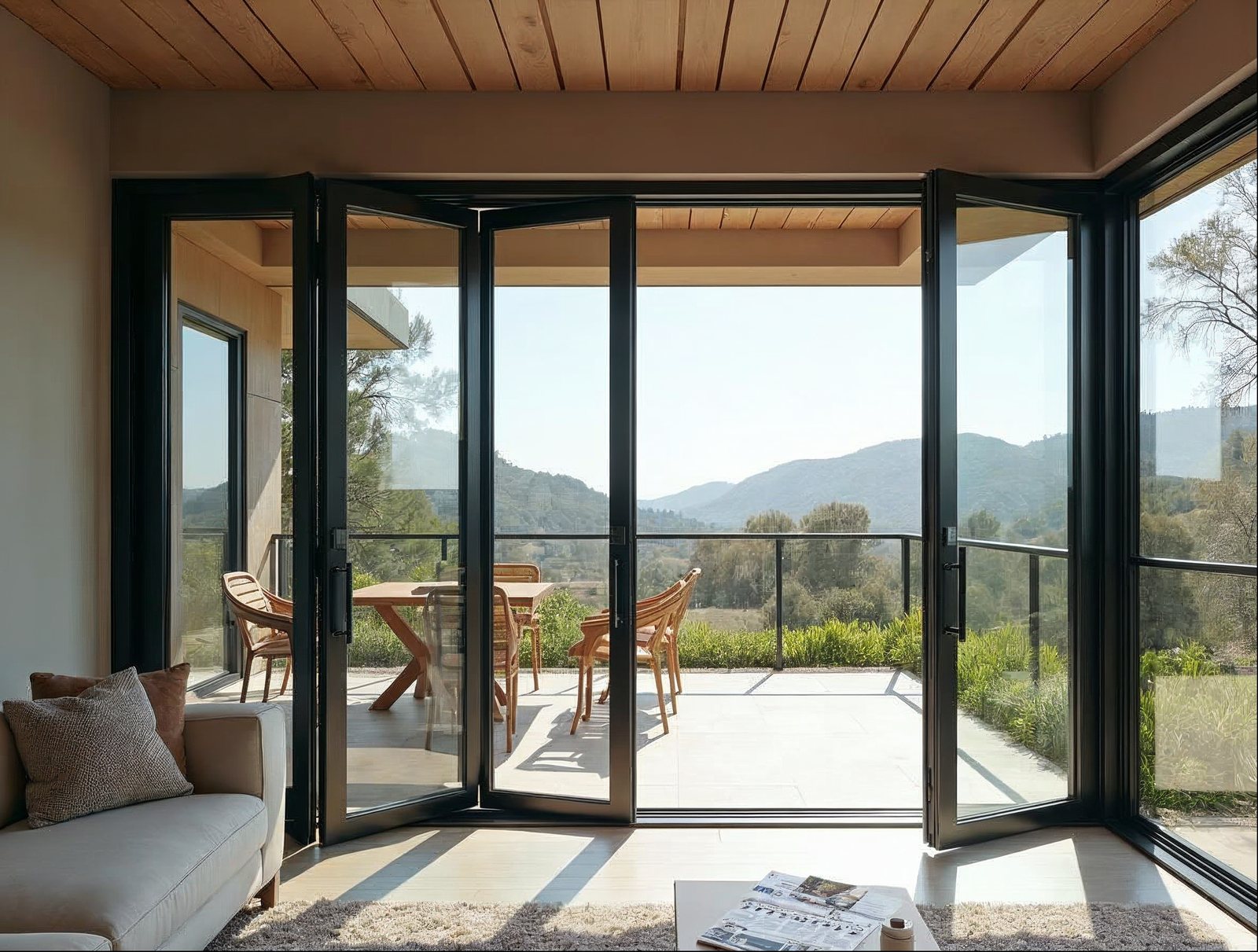
What factors drive the cost of large folding patio doors up or down?
Panel count, glass specification, frame finish, and opening dimensions are the four biggest cost levers on any large bi-fold door project — and each interacts with the others.
1. Panel Count and Total Width
Each additional panel adds aluminum, glass, hardware, and weight-bearing load to the header. A 4-panel system at 16 ft is structurally and materially different from an 8-panel system at the same rough opening. More panels also mean more hinge sets, more weatherstripping runs, and a heavier track assembly. Budget roughly $3,500–$5,500 per panel as a working estimate for a premium thermal-break aluminum system with 6mm glass at trade pricing.
2. Glass Specification
Glass is frequently 40–55% of the total unit cost on a large folding door. Gladiator's standard is 6mm tempered glass, which provides meaningful thermal mass and strength beyond the thinner 4mm glass common in entry-level or legacy-brand folding systems. Upgrading to a low-E coating (for SHGC and U-factor compliance with California Title 24 or other energy codes) adds cost, as does specifying tempered-laminated, tinted, or frosted glass. For commercial projects or buildings in direct sun exposure, low-E dual-pane insulated glass units (IGUs) are the correct spec and carry a cost premium of 20–35% over clear single-pane.
3. Frame Finish
Matte black and dark grey RAL 7016 powder coat are the most-specified finishes in architectural projects and are standard pricing. White RAL 9010 and bronze anodized are also available. Custom RAL colors or anodized finishes beyond the standard four carry a lead-time and cost premium — plan for an additional 10–20% on the frame line item and extended lead times for non-stock finishes.
4. Panel Height
Standard panel heights to approximately 8 ft are the most cost-efficient. Panels in the 9–10 ft range increase glass area, hardware load, and shipping complexity. True floor-to-ceiling panels in high-ceiling projects (10 ft+) are available as configured-to-order units and will sit at the higher end of the per-panel cost range.
5. Configuration: Bottom-Roll vs. Top-Hung
Bottom-rolling track systems distribute panel weight across the floor track, making them practical for spans beyond 24 ft without extraordinary header engineering. Top-hung systems carry all weight from the header, which simplifies the floor finish detail (flush or recessed track) but demands more structural header depth. Top-hung systems generally carry a slight hardware premium for large-span configurations. Both are available in Gladiator's aluminum bi-fold door systems.
6. In-Stock vs. Configured-to-Order
Standard sizes held in stock at Gladiator's Florida and California warehouses ship significantly faster than configured-to-order units — and because they move at volume, they carry no custom-fabrication premium. Checking in-stock doors ready to ship before specifying a custom size can save both time and meaningful dollars on projects where a standard size fits the rough opening.
How does bi-fold door cost compare between standard and oversized openings?
Standard openings (roughly 10–20 ft wide, up to 8 ft tall) are the most cost-efficient configuration — they use stock panel widths, ship from existing inventory, and require the least structural intervention. Oversized openings introduce cost at every layer of the project.
| Factor | Standard Opening (10–20 ft) | Oversized Opening (24–36 ft+) |
|---|---|---|
| Panel width per leaf | 24–36 in typical | Up to 48 in — wider panels, more glass area |
| Header engineering | Standard LVL or steel beam | Deep steel beam or built-up header often required |
| Glass area per unit | Lower — fewer/smaller panels | High — glass cost scales with every square foot |
| Lead time | In-stock sizes ship in days; configured 4–8 weeks | Configured-to-order; typically 6–12 weeks |
| Shipping complexity | Standard LTL freight | Oversized freight; may require liftgate + team delivery |
| Installation crew size | 2-person crew typical | 3–4 person crew; crane assist for very large panels |
| Structural rough opening prep | Lower cost; standard framing | Higher cost; structural engineer review recommended |
| Gladiator factory-direct pricing advantage | Strong — volume stock pricing | Strong — no dealer markup on configured units |
The practical takeaway for builders: every foot of width beyond 20 ft adds cost non-linearly. Header depth, glass area, panel hardware, and shipping weight all scale up together. Planning the rough opening at a standard panel-width increment (multiples of 24, 28, or 36 in depending on the system) avoids custom panel cuts and keeps unit cost at the most favorable tier.
For projects specifying multiple large openings — multi-unit residential, mixed-use, resort, or hospitality — this is where factory-direct wholesale pricing delivers the clearest ROI. See how Gladiator's folding door systems are configured for large-span commercial and residential applications.
What does labor cost to install bi-fold doors on a new construction project?
Labor to install large exterior bi-fold doors on a new construction project typically runs $2,000–$10,000+ depending on opening size, crew experience, site conditions, and local market rates — with the highest costs concentrated in large-span, high-ceiling, or multi-floor installations.
Labor Cost Breakdown by Task
- Rough opening prep and header installation: $800–$3,500. The header is the most critical structural element. A large bi-fold door transfers all panel weight (glass is heavy — 6mm tempered at full panel size can weigh 150–300+ lb per leaf) to the header and surrounding framing. This is where under-built openings become expensive problems. For spans over 20 ft, a structural engineer review of the header design is strongly recommended and is money well spent.
- Track and frame setting: $500–$2,000. Setting the sill track plumb, level, and square across a long span is precision work. Low-profile sill track flush with the finished floor requires careful subfloor coordination and is best planned before the slab pour or subfloor install on new construction.
- Panel hanging and adjustment: $600–$2,500. Each panel must be plumb, level, and adjusted for smooth operation and weathertight closure. On a 6–8 panel system, this is a half-day to full-day task for an experienced crew.
- Weatherstripping and hardware final set: $300–$1,000. Multi-point locking systems, flush bolts, and perimeter seals require careful fitting and adjustment. Rushing this step is the most common cause of field service calls post-installation.
- Cleanup and caulking/flashing: $200–$800. Flashing and sill pan waterproofing details matter for long-term performance and warranty compliance.
New Construction vs. Retrofit
New construction is the lower-cost installation scenario. The rough opening can be framed and the slab or subfloor detailed correctly from the start. Retrofit installations into existing openings — especially masonry, concrete, or steel-frame buildings — routinely add $2,000–$6,000 in demo, structural modification, and finish restoration work. Specifying the door system early in the design process (and sharing the rough opening and header requirements with the structural engineer at schematic design) eliminates expensive mid-construction changes.
Crew Sizing Guidelines
- Up to 4 panels / 16 ft: 2-person crew, 1 day
- 5–6 panels / 20–24 ft: 2–3 person crew, 1–2 days
- 7–8 panels / 28–32 ft: 3-person crew, 2 days
- 9–10 panels / 36 ft+: 4-person crew, 2–3 days; consider mechanical assist for panel lifting
How do you get factory-direct pricing on large aluminum bi-fold doors?
Factory-direct pricing on large aluminum bi-fold doors means purchasing directly from the source — no dealer margin, no showroom overhead, no regional distributor markup — which typically saves contractors and builders 15–35% compared to purchasing the same specification through a traditional dealer network.
What Factory-Direct Actually Means for Your Project Budget
At Gladiator, factory-direct means the price you see is the trade price — not a consumer MSRP with a dealer discount applied on top. For a contractor running 10–50 large-opening projects per year, this difference is material. A $5,000 per-unit saving across 20 units is $100,000 in margin that stays in your business or goes back to your client as competitive pricing. Gladiator offers formal wholesale and reseller accounts for contractors, builders, developers, glaziers, and dealers who want structured trade pricing, volume tiers, and dedicated support.
The Ordering Process for Large Configured-to-Order Systems
- Submit your rough opening dimensions and configuration. Gladiator's trade team reviews your opening width, height, panel count, swing direction, finish, and glass spec. Standard panel widths are 24, 28, 32, 36, and 48 inches depending on the system; confirming your RO is a multiple of the panel width before ordering avoids costly field modifications.
- Receive a formal quote with line-item pricing. No bundled mystery pricing. You see glass cost, frame cost, hardware, and shipping as separate line items — which makes it easy to value-engineer the spec if needed.
- Confirm lead time. In-stock standard sizes ship within days from Florida or California warehouses. Configured-to-order systems: plan for 6–12 weeks for large-span or non-standard configurations. Build this into your project schedule at permit stage, not two weeks before door installation.
- Free nationwide shipping. Gladiator ships freight-included to all 50 states. For large bi-fold systems, confirm delivery logistics with the site super — oversized panels require a clear staging area and receiving crew on delivery day.
- Technical support through installation. Trade account holders get direct access to Gladiator's technical team for RO verification, header planning, and installation questions — not a call center script.
Gladiator Bi-Fold System Specs at a Glance
- Frame: Thermal-break aluminum — superior thermal performance vs. non-thermally-broken aluminum frames common in lower-cost systems
- Glass: 6mm tempered standard; low-E dual-pane IGU available for California Title 24 and other energy-code projects
- Panel configurations: 2 to 10 panels; widths from ~24 in to 48 in per leaf
- Panel heights: up to 10 ft standard; taller on configured-to-order basis
- Finishes: matte black, dark grey RAL 7016, white RAL 9010, bronze anodized — custom RAL available
- Track: low-profile sill track, flush-floor compatible on new construction
- Warranty: 15-year warranty on frames and hardware
- Shipping: free nationwide, all 50 states
For projects that also include sliding glass doors, pivot doors, or folding passthrough windows, a wholesale account gives you unified trade pricing across Gladiator's full aluminum system line — one relationship, one trade account, one support contact for all your aluminum door and window needs.
Apply for a Reseller & Wholesale Account to access trade pricing, volume tiers, and dedicated project support. Contractors, builders, developers, glaziers, and dealers are all eligible.
Sell Gladiator doors at a wholesale price. Factory-direct aluminum sliding, bi-fold, and pivot doors — premium aluminum, 6mm glass, low-profile tracks, no upcharges, shipped nationwide. Contractors, builders, designers, and retailers get trade pricing and real support.
Apply for a Reseller & Wholesale Account · Call 904-822-1078


