


 904-822-1078

What Types of Large Sliding Glass Doors Are Available for a Patio or Exterior Opening?
There are four principal configurations to consider for a large patio opening: two-panel sliders, multi-slide systems, pocket sliders, and stacking (or "lift-and-slide") systems — each suited to a different span, budget, and architectural goal.
- Two-panel sliding patio door. The classic format — one fixed panel, one operable panel. Spans typically run from 60 inches up to 96 inches wide. Best for standard openings where you want simplicity and low maintenance.
- Multi-slide door system. Multiple panels that travel on parallel tracks to one or both sides of the opening. These systems routinely span 12, 16, 20, even 32 feet or more, making them the go-to choice for wide patio walls, great rooms, and indoor-outdoor living projects.
- Pocket sliding system. Panels retract fully into a wall cavity, delivering a completely unobstructed opening — architectural theater at its finest. Requires additional framing depth and planning during the rough-opening stage.
- Lift-and-slide system. A European-derived mechanism in which the panel lifts slightly off its threshold seals during operation for ultra-smooth movement, then drops back down to compress the weatherstripping when locked. Ideal for very heavy, thermally broken panels in large spans.
At Gladiator Window & Doors, our sliding glass door collection spans all four configurations in thermally broken aluminum with 6 mm standard glass, available in matte black, dark grey RAL 7016, white RAL 9010, and bronze anodized finishes. Standard sizes are kept in stock for faster lead times — see our in-stock doors ready to ship if your project timeline is tight.
Homeowners who want maximum glass area but prefer a folding configuration instead of a slider may also want to review our bi-fold accordion door systems, which stack neatly to one side and open nearly the full width of the frame.
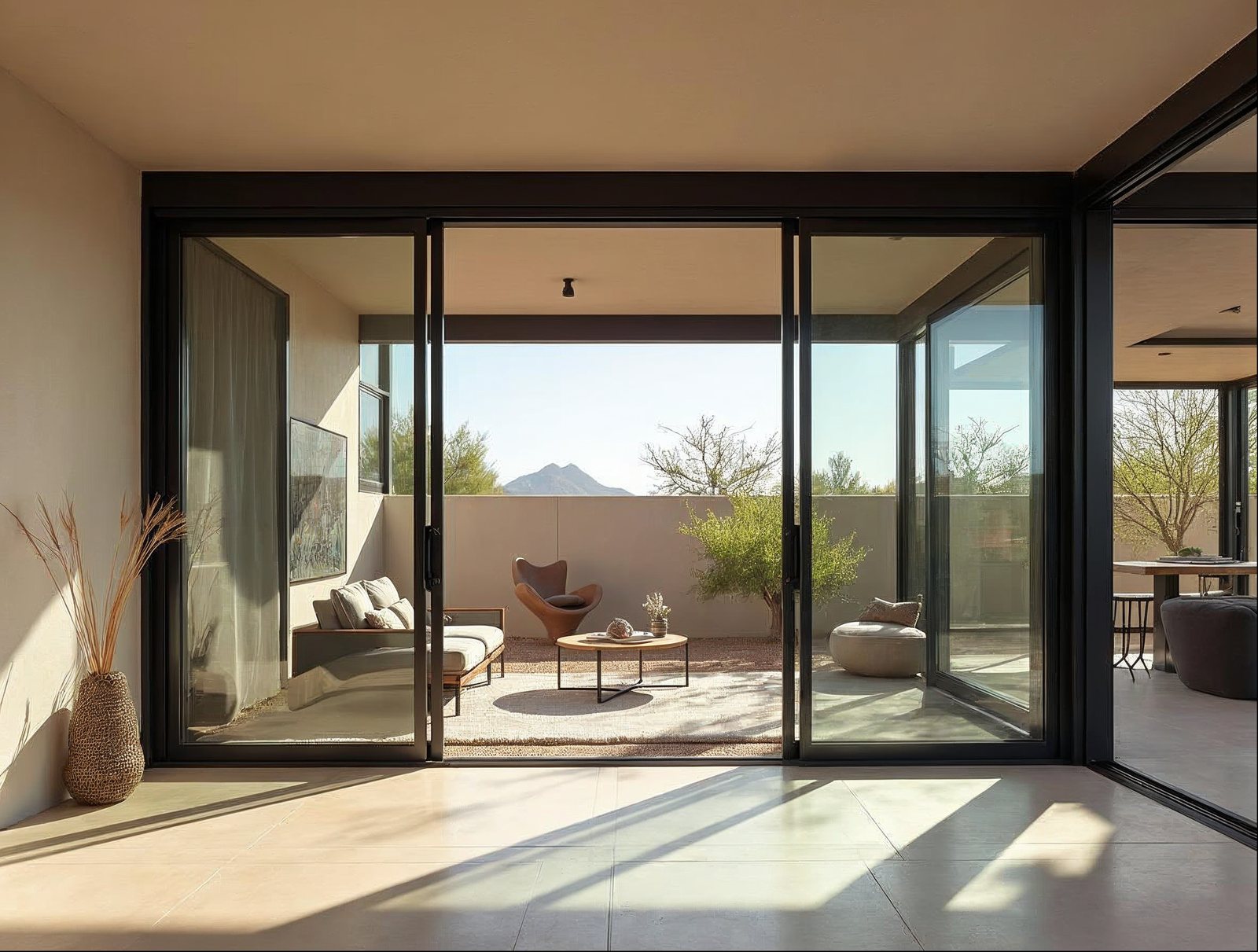
How Much Do New Large Sliding Glass Doors Cost, and What Drives the Price?
For a quality thermally broken aluminum sliding glass door system, budget roughly $3,000–$7,500 for a standard two-panel unit and $8,000–$30,000+ for a multi-slide system spanning 12–32 feet — door only, before installation labor.
Several variables move that number up or down:
- Width and panel count. Every additional panel adds glass area, hardware, track length, and weight-bearing requirements. A 3-panel, 12-foot system costs substantially less than a 6-panel, 24-foot run.
- Frame material and thermal performance. Thermally broken aluminum — the standard at Gladiator — commands a premium over non-broken aluminum but delivers meaningfully better energy performance and qualifies for energy-efficiency incentives in many states. Vinyl and unbroken aluminum cost less upfront but carry long-term energy penalties in large-span applications.
- Glass specification. Standard 6 mm dual-pane low-E glass is included at our base price. Upgrading to triple-pane, acoustic laminate, or specialty tints adds cost but may be appropriate for north-facing rooms, home theaters, or street-facing patios.
- Hardware grade. Mortise lock systems, multi-point locking, and precision roller assemblies for heavy panels cost more than basic hardware — but on a door spanning 16+ feet, hardware quality directly affects day-to-day ease of operation for the life of the product.
- Factory-direct vs. dealer-network purchasing. Buying through a dealer network typically adds 30–50% in distributor and retailer margin. Because Gladiator ships factory-direct with free nationwide shipping to all 50 states, you pay closer to true manufacturing cost — no intermediary markups.
- Custom vs. in-stock sizing. Made-to-order custom dimensions carry longer lead times and slightly higher unit costs. Standard stocked dimensions ship faster and are priced lower — check our in-stock inventory page before committing to a custom order.
What Is the Difference Between a Sliding Patio Door and a Multi-Slide Glass Door System?
A traditional sliding patio door is a two- or three-panel unit designed for openings up to roughly 10 feet wide, while a multi-slide system is an engineered wall of glass — typically 4 to 10+ panels — engineered to span 12 to 40 feet with coordinated hardware, structural rails, and precision track systems designed for the load.
The practical differences come down to five things:
| Feature | Standard Sliding Patio Door | Multi-Slide System |
|---|---|---|
| Typical width range | 5 ft – 10 ft | 10 ft – 40 ft+ |
| Panel count | 2–3 panels | 4–10+ panels |
| Glass area | Moderate | Expansive / wall-of-glass |
| Track complexity | Single or dual track | Multi-track; pocket or stacking options |
| Structural requirement | Standard header | Engineered beam / structural header required |
| Ideal use case | Standard bedroom or living room patio access | Great room, pool deck, entertainment terrace |
For large openings, a multi-slide system is rarely just a style choice — it is often the only structurally appropriate way to deliver the glass area the design calls for. Trying to approximate a 20-foot opening with multiple standard two-panel doors introduces unnecessary vertical mullions, inconsistent sightlines, and mismatched hardware.
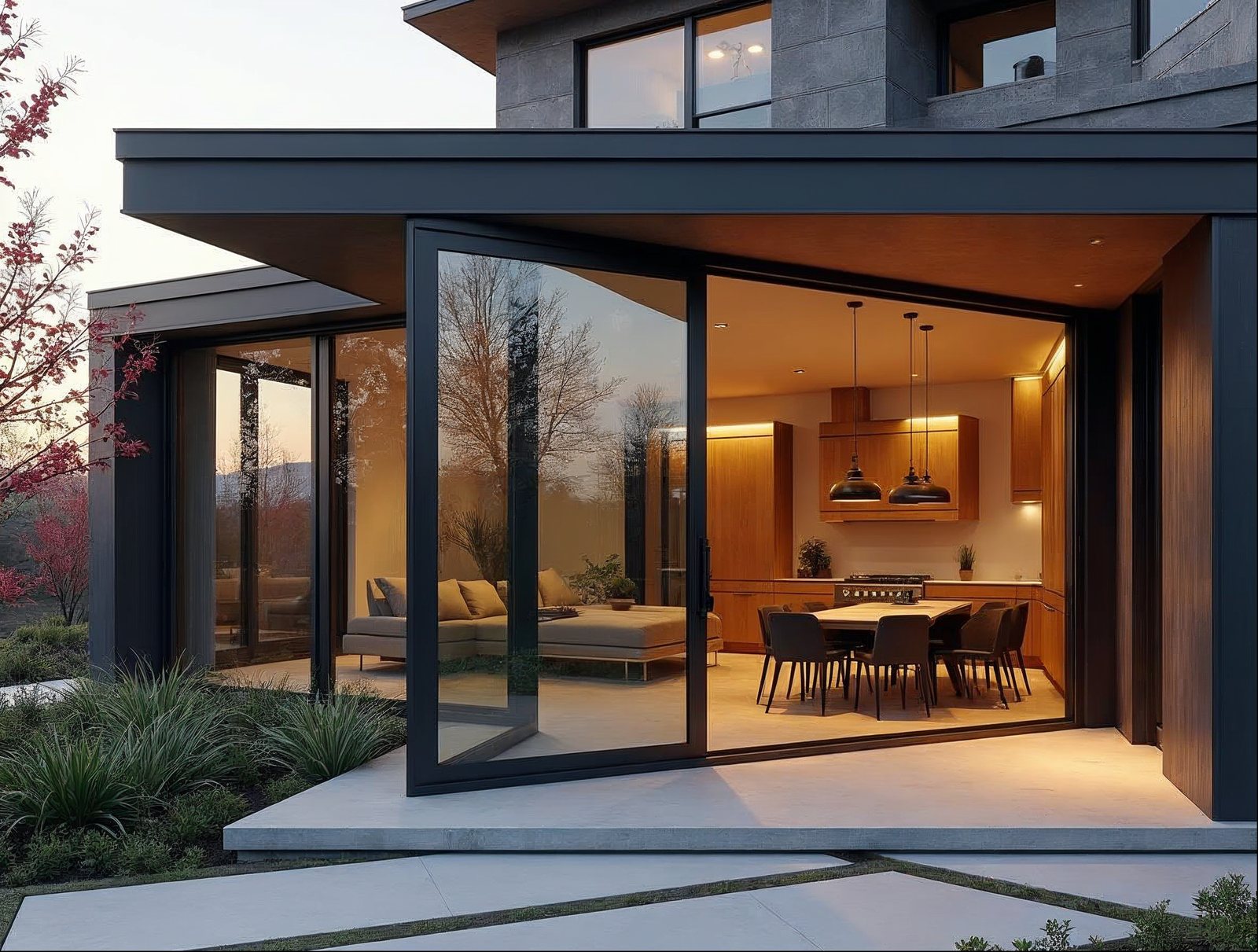
Are Energy-Efficient Sliding Glass Doors Worth the Extra Cost for a Large Patio Opening?
Yes — and the larger the opening, the faster the payback. At scale, glass area is your biggest source of heat gain in summer and heat loss in winter, so thermal performance on a 20-foot sliding wall matters far more than it does on a small window.
Here is what to look for when evaluating thermal performance:
- Thermal break. A structural polyamide barrier separating the interior and exterior aluminum profiles prevents the frame itself from acting as a heat conductor. All Gladiator sliding systems use continuous thermal-break construction. Non-broken aluminum frames can become condensation points in colder climates and significantly degrade your whole-door U-factor.
- Whole-door NFRC U-factor. This is the number that actually matters — it measures total heat transfer across the entire door unit (frame + glass + edge seal), not just the center-of-glass. Ask for the whole-door U-factor, not the glass-only rating.
- Low-E coating. A spectrally selective low-emissivity coating on the interior glass surface reduces radiant heat transfer. Paired with an argon gas fill in the insulated glass unit, a well-specified low-E pane can dramatically lower solar heat gain coefficient (SHGC) without sacrificing visible light.
- California Title 24 compliance. If your project is in California, residential glazing must meet Title 24 energy code requirements. Thermally broken, low-E systems typically comply; verify with your contractor using the CEC's residential compliance manual and the specific NFRC-rated U-factor for the unit you're ordering.
From a financial standpoint, energy-efficient glazing on a large patio opening reduces HVAC load year-round. In warm climates, lower solar heat gain cuts cooling costs during peak summer months. In cold climates, a lower U-factor reduces heat loss during winter. When amortized over the 15-year warranty period standard with Gladiator systems, the energy savings routinely offset the incremental cost of upgraded glass specs.
How Much Does It Cost to Have a Large Sliding Glass Door Installed Including Labor?
Installation labor for a large sliding glass door typically adds $800–$3,500 to the total project cost, depending on the size and complexity of the opening, with multi-slide systems at the high end of that range.
The key cost drivers for labor are:
- Opening size and structural work. A 16-foot multi-slide system requires a properly engineered header or beam — if that isn't already in place, structural work adds to the contractor's scope and the overall budget. Always budget for a structural assessment on large openings.
- Removal and disposal of existing door or wall. Replacing an existing door runs $200–$600 for removal. Expanding an existing opening (removing drywall, framing, and reconfiguring) adds significantly more, particularly in load-bearing walls.
- Sill and threshold work. Low-profile threshold systems require precise sub-floor or concrete preparation for a flush, trippable-free result. This is detail work; rushing it causes alignment problems with the finished panels.
- Finish work. Drywall patching, trim, interior casing, and exterior weather-sealing are separate line items that vary by finish material and region. Budget $300–$1,000 for finish trades on a large system.
- Geography. Labor rates vary considerably by region. Urban West Coast and Northeast markets run higher than the national average; suburban Midwest and Southeast markets generally run lower.
Total installed cost summary (door + labor + finish work, typical ranges):
| System Type | Door Cost (Factory-Direct) | Est. Total Installed |
|---|---|---|
| Two-panel slider (6–8 ft) | $3,000–$5,500 | $4,500–$8,000 |
| Three-panel multi-slide (10–12 ft) | $6,000–$10,000 | $8,500–$14,000 |
| Four- to six-panel multi-slide (16–24 ft) | $12,000–$22,000 | $16,000–$28,000 |
| Eight-panel+ multi-slide (28–40 ft) | $22,000–$35,000+ | $28,000–$45,000+ |
These ranges reflect thermally broken aluminum systems with standard low-E glass. Pocket configurations, specialty glass, or significant structural work will push costs toward or beyond the top of each range. Buying factory-direct from Gladiator removes dealer margin from the door cost line — typically the largest single variable in the total budget.
Builders, contractors, and architects working on multiple projects can apply for our reseller and wholesale program for volume pricing and dedicated project support. If you're comparing patio door formats, our full sliding glass door lineup and our bi-fold door collection are both worth reviewing side by side before committing to a configuration.
Ready to Spec Your Patio Opening?
Use our in-stock inventory page to find standard sizes ready to ship, or configure a custom system directly with our team. Free shipping to all 50 states. Fifteen-year warranty. No dealers, no markups — just the door.


