


 904-822-1078

For large sliding glass door openings — anything over 8 feet wide and especially multi-slide systems beyond 12 feet — thermal-break aluminum is the clear specification choice. Vinyl's inherent structural limitations cap practical panel sizes, complicate header engineering, and degrade under long-term UV exposure. Aluminum systems, by contrast, are dimensionally stable, carry greater glass loads, and are manufactured to tighter tolerances that matter on commercial and high-end residential jobs. This guide walks contractors, builders, architects, and dealers through every key decision point so you can spec with confidence and price accurately from the start.
Written by the Gladiator Window & Doors technical team — a factory-direct aluminum door and window manufacturer based in Jacksonville, Florida, shipping custom and in-stock systems to all 50 states.
How does the structural strength of aluminum compare to vinyl for wide sliding door panels?
Aluminum is dramatically stronger than vinyl at equivalent cross-section dimensions, which is the defining factor once panel widths exceed 4 feet per leaf. Aluminum profiles have a tensile strength roughly 15–20× greater than standard PVC extrusions. That difference is not theoretical — it determines whether a panel can carry its own glass weight, resist operational racking, and maintain squareness over decades of daily use.
In practice, a standard vinyl sliding door panel begins to deflect noticeably above 48 inches wide and requires increasingly heavy-walled extrusions that add bulk and reduce the sight-line clarity architects want. Aluminum profiles achieve the same rigidity at a fraction of the wall thickness, which is why you routinely see aluminum multi-slide panels running 60–72 inches wide per leaf without compromising frame geometry. Gladiator's aluminum sliding door frames are engineered specifically for multi-panel stacking configurations, and the same profile handles the structural demands of 2-, 3-, 4-, and 6-panel layouts without custom reinforcement.
Header engineering is also simplified. Because aluminum panels are lighter per square foot of opening than heavy-walled vinyl, the structural load transfer to the rough opening header is more predictable. Gladiator provides rough-opening and header loading guidance at the time of order — a practical step that eliminates the back-and-forth that typically delays project scheduling.
What are the long-term maintenance differences between aluminum and vinyl sliding doors?
Aluminum sliding doors require virtually no structural maintenance over their service life; vinyl systems require ongoing inspection and eventual replacement due to UV-induced degradation and thermal deformation. This is one of the most consequential differences for builders offering warranties and developers managing building operations over decades.
Vinyl (PVC) expands and contracts significantly with temperature swings — coefficients of thermal expansion roughly 4–5× that of aluminum. In climates with wide daily or seasonal temperature ranges, this cyclical movement works fasteners loose, distorts weatherstripping seats, and causes seals to fail prematurely. In sustained high-UV environments, unstabilized vinyl becomes brittle and chalks, and even UV-stabilized vinyl loses color fidelity and surface integrity within 10–15 years on south- and west-facing facades.
Aluminum doesn't chalk, crack, or warp. Powder-coat finishes on aluminum frames — including Gladiator's standard matte black, dark grey RAL 7016, white RAL 9010, and bronze anodized options — are tested to resist fading and corrosion. Hardware remains tight because the substrate doesn't move. Gladiator backs its aluminum systems with a 15-year warranty, a commitment that reflects the material's actual service life, not a marketing position.
For trade buyers: when you spec aluminum once, you're not revisiting that opening at year 12 because the frame has deformed and the owner wants answers.
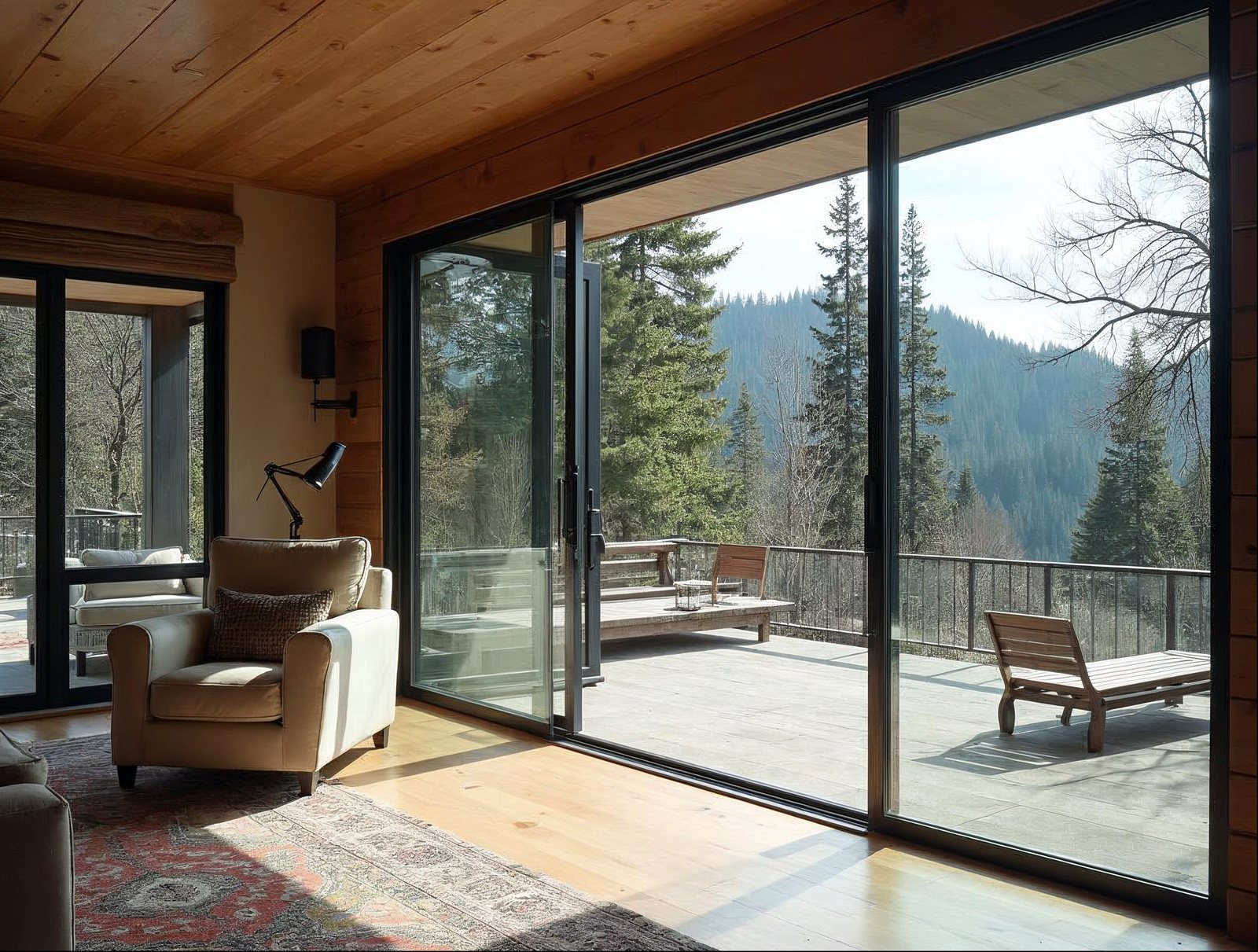
Which material allows for larger panel sizes — aluminum or vinyl?
Aluminum allows significantly larger individual panel sizes than vinyl — a practical ceiling of roughly 36–40 square feet per panel for vinyl versus 60–80+ square feet per panel for engineered aluminum systems. For any multi-slide or stacking door system over 10 feet wide, vinyl simply isn't a viable material choice at standard frame depths.
Gladiator's aluminum sliding glass doors are available in panel widths up to 72 inches per leaf and heights to match modern floor-to-ceiling applications. Standard 6mm glass is included — not a paid upgrade — which matters for large panels where thinner glass would introduce unacceptable deflection. Configurations include 2-panel (one fixed, one sliding), 3-panel, 4-panel stacking, and 6-panel stacking layouts, with panels stacking left, right, or to both sides depending on the opening plan.
For comparison, most vinyl sliding systems top out at a 2- or 3-panel configuration with individual panels no wider than 48 inches. Attempting to push beyond those limits results in extrusion warping, track-binding from uneven loading, and callbacks. On a project where the design intent is an unobstructed 20- or 24-foot glass wall, vinyl is a non-starter — the framing depth and panel count required make it visually and functionally incompatible with the design.
How do the thermal performance ratings of aluminum and vinyl sliding doors compare?
Modern thermal-break aluminum systems achieve U-factors competitive with — and in whole-door NFRC ratings sometimes equal to — standard vinyl systems, closing the energy-performance gap that defined the aluminum vs. vinyl debate a generation ago. The key is the thermal break: a low-conductivity polyamide or polymer barrier that interrupts the aluminum frame's conductive path between interior and exterior surfaces.
Gladiator sliding doors use thermal-break aluminum frames and carry whole-door NFRC U-factor ratings. Paired with the standard 6mm glass (available in dual-pane insulated glass unit configurations with low-e coatings and inert gas fills), the system meets California Title 24 energy compliance thresholds — the most rigorous residential energy code in the U.S. — and is spec-ready for energy-conscious projects nationwide.
Vinyl frames achieve low U-factors primarily because PVC is a poor conductor of heat, but that thermal advantage is partially offset at scale: large vinyl panels lose edge-of-glass performance as the perimeter-to-area ratio changes, and vinyl spacers in the IGU can underperform warm-edge aluminum spacers used in commercial-grade aluminum door systems. On a whole-door NFRC basis — which is the only apples-to-apples comparison that matters for energy code compliance — a properly specified thermal-break aluminum door frequently meets the same threshold as a comparable vinyl unit.
For California Title 24 projects and projects seeking LEED or equivalent energy credits, specifying a thermal-break aluminum system with NFRC documentation is both sufficient and straightforward. Gladiator provides full NFRC documentation with system orders.
Is aluminum or vinyl more cost-effective for multi-slide door systems over 12 feet wide?
Aluminum is more cost-effective than vinyl for multi-slide systems over 12 feet wide when you account for total installed cost, longevity, and callback risk — not just the sticker price of the door unit. At the unit level, a standard vinyl slider may appear less expensive at 8–10 feet wide, but that advantage disappears rapidly as opening width increases.
Here's why: vinyl manufacturers achieve large openings by adding panels and reinforcing profiles, which drives up material costs and weight — and then the unit still carries all the long-term liability described above. Meanwhile, factory-direct aluminum systems like Gladiator's are priced without dealer markup, distributor margin, or big-box retail overhead. Because Gladiator manufactures and ships direct, trade buyers access pricing that reflects actual production cost, not a multi-tier distribution chain.
Gladiator offers free nationwide shipping on its systems — a line item that typically runs $300–$800 per unit through traditional distribution — and in-stock doors ready to ship on standard configurations, reducing lead times that can otherwise stretch 12–16 weeks through dealer-network brands. For production builders and developers running multiple units per project, the pricing difference between factory-direct aluminum and dealer-sourced vinyl at comparable quality levels is often negligible or inverted.
For resellers and contractors: Gladiator's wholesale trade accounts provide additional tier pricing on volume, making aluminum the defensible choice to present to clients without sacrificing margin.
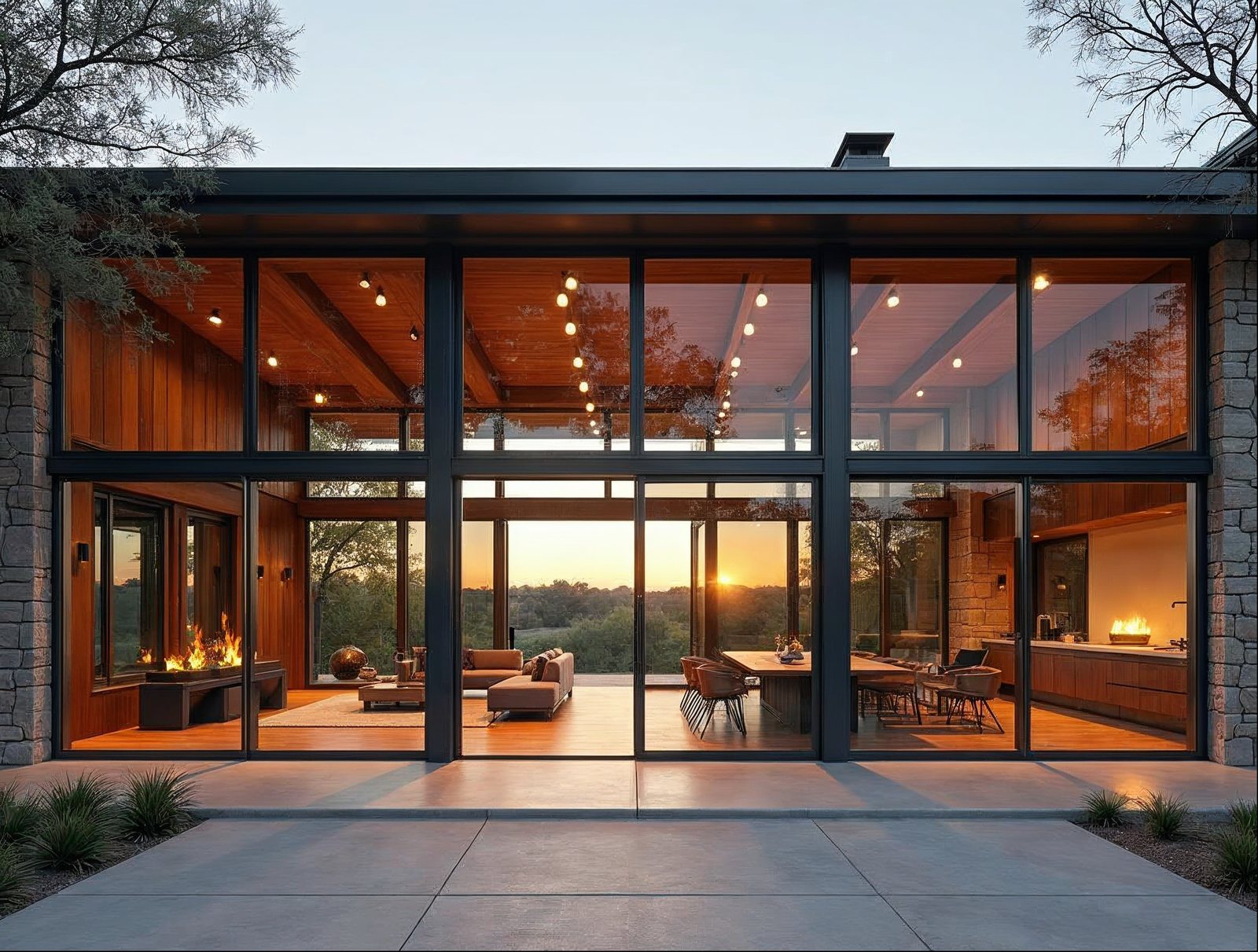
Aluminum vs. Vinyl Sliding Door Specification Comparison
| Specification Factor | Gladiator Thermal-Break Aluminum | Standard Vinyl (PVC) Sliding Systems | Heavy-Wall Vinyl (Reinforced) |
|---|---|---|---|
| Max practical panel width | Up to 72 in. per leaf | Typically 36–48 in. per leaf | Up to ~54 in. with steel reinforcement |
| Max total opening width | 20 ft+ (multi-panel stacking) | 10–12 ft typical practical limit | 12–16 ft with added panels |
| Glass standard | 6mm glass, dual-pane IGU, low-e | Dual-pane IGU; glass weight limits panel size | Dual-pane IGU; heavy frame offsets glass savings |
| Frame thermal performance | Thermal-break aluminum, whole-door NFRC U-factor | PVC conduction-break, whole-door NFRC rated | PVC conduction-break; heavier frame adds conductive edge |
| Long-term UV stability | Excellent — powder-coat finish, no chalking | Moderate — UV stabilized but degrades 10–15 yr | Moderate — same PVC limitations |
| Thermal expansion / movement | Low — dimensionally stable | High — 4–5× aluminum's expansion rate | High — reinforcement reduces but doesn't eliminate movement |
| Available configurations | 2-, 3-, 4-, 6-panel; stack L/R/both; pocket option | 2- or 3-panel standard; limited stacking | 2- or 3-panel; limited stacking |
| Finish options | Matte black, RAL 7016, RAL 9010, bronze anodized | White, tan, limited colors | White, tan, limited laminate options |
| Warranty | 15 years | Typically 10 years (prorated) | Typically 10 years (prorated) |
| Shipping | Free nationwide — factory direct | Freight billed through dealer network | Freight billed through dealer network |
| Lead time (standard sizes) | In-stock ships fast; custom 4–8 weeks typical | 4–10 weeks through dealer chain | 6–12 weeks through dealer chain |
| Trade / wholesale pricing | Factory-direct — no distributor markup | Dealer-network pricing applies | Dealer-network pricing applies |
Why do most architects and contractors spec aluminum over vinyl for large glass door openings?
Architects and contractors default to thermal-break aluminum for large sliding glass door openings because the material reliably delivers on the four things that matter most at project close-out: structural integrity at scale, dimensional precision for tight tolerances, long-term aesthetic durability, and a clean NFRC paper trail for energy compliance. Vinyl can satisfy some of these criteria at modest sizes — it cannot satisfy all of them at large openings simultaneously.
From a design standpoint, aluminum's narrower sight lines are a fundamental aesthetic advantage. A structural aluminum sliding door frame at 72-inch panel width will have a visible stile width of roughly 2–3 inches; the equivalent heavy-wall vinyl frame must be 4–5 inches wide to achieve comparable strength, visually interrupting the glass plane the architect designed around. On projects where the glass wall is the architectural statement — indoor-outdoor living, commercial lobbies, hospitality, high-end multi-family — the sight-line difference is non-negotiable.
From a liability standpoint, aluminum's dimensional stability means the door that passes final inspection performs the same way at year 10 as it did at year 1. Contractors managing warranty callbacks understand that vinyl's thermal movement means callbacks are not a question of if, but when, on west-facing and south-facing exposures in warm climates.
Gladiator's multi-slide aluminum sliding doors are specified alongside our aluminum bi-fold door systems for projects requiring maximum opening width, and alongside our architectural pivot doors for statement entries. The same factory-direct model — no middlemen, no upcharges, full technical support — applies across every product line. Contractors and dealers who carry Gladiator can offer the complete aluminum opening package at pricing that competes with dealer-sourced mid-grade vinyl on a whole-project basis.
If you're evaluating aluminum sliding systems for a current project, also see our guides on folding passthrough windows for bar and kitchen pass-through applications that complement large sliding door specs.
Sell Gladiator doors at a wholesale price. Factory-direct aluminum sliding, bi-fold, and pivot doors — premium aluminum, 6mm glass, low-profile tracks, no upcharges, shipped nationwide. Contractors, builders, designers, and retailers get trade pricing and real support.
Apply for a Reseller & Wholesale Account · Call 904-822-1078


