


 904-822-1078

Are aluminum bi-fold doors a good idea for a large patio opening?
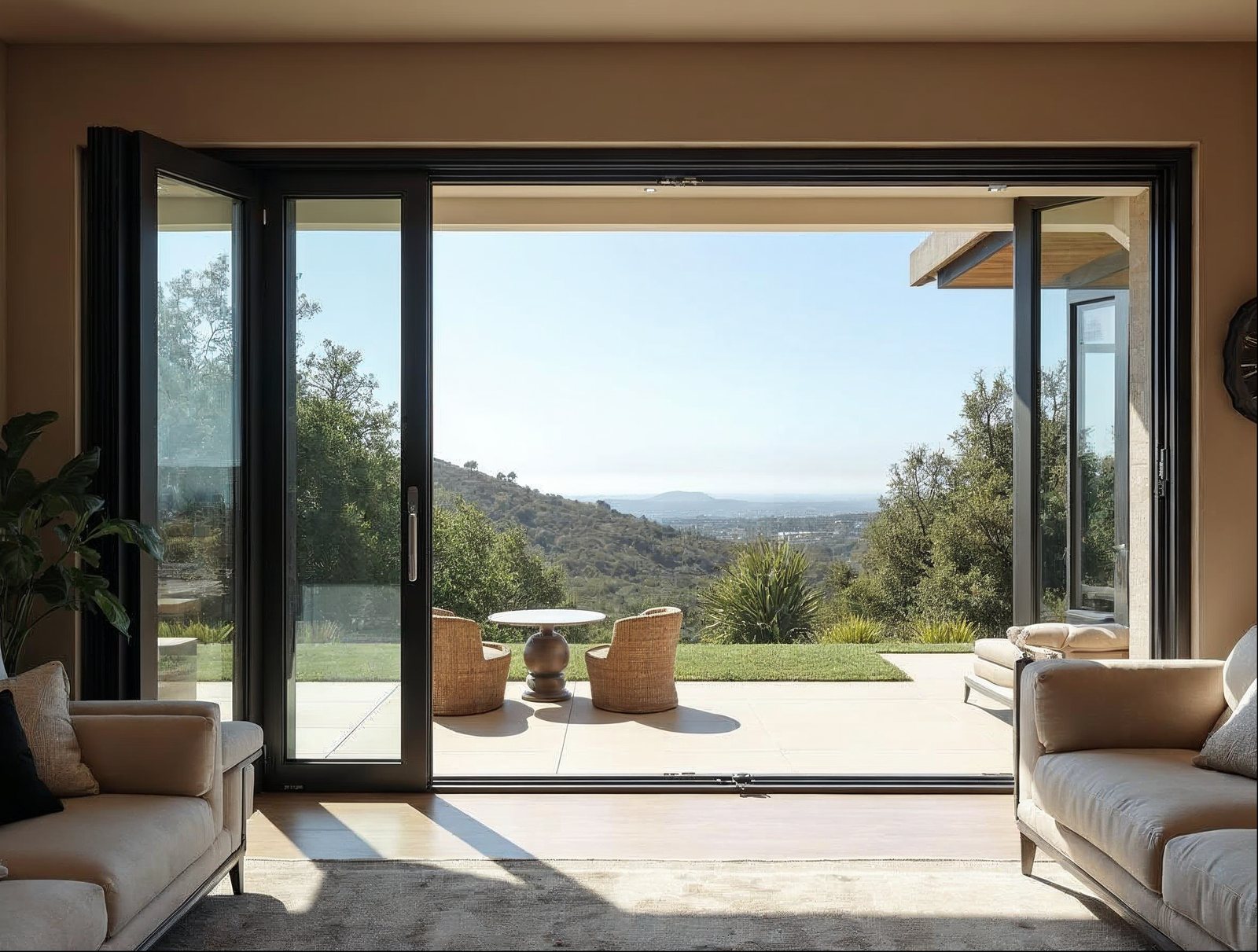
Yes — aluminum bi-fold doors are one of the most architecturally capable solutions available for wide patio openings, spanning anywhere from 8 feet to 32 feet or more in a single unobstructed run. Unlike traditional sliding doors that stack panels on one side and always leave part of the glass in the way, a folding system collapses its entire panel stack at one or both ends, turning a wall into a fully open passage. That makes them a genuine design upgrade for living rooms, dining areas, and covered outdoor spaces where you want indoor-outdoor flow, not just a view.
Aluminum is the right frame material at this scale. It is dimensionally stable — it does not warp, swell, or shrink with humidity changes the way wood or wood-clad systems can over time. Its high strength-to-weight ratio allows slimmer sightlines and taller panel heights without sacrificing structural integrity. A thermal-break aluminum profile adds an insulating barrier inside the frame, separating the interior and exterior metal surfaces so that condensation and heat transfer are dramatically reduced. For large glass openings, that thermal performance detail matters far more than it might on a standard window.
Gladiator's aluminum bi-fold doors are available in standard configurations that ship from stock, as well as fully custom widths and heights to fit your specific rough opening. Whether you are connecting a great room to a pool deck or opening a commercial dining space to a patio, the system scales cleanly.
How reliable are aluminum bi-fold door systems over years of daily use?
A well-engineered aluminum bi-fold door system is highly reliable over decades of daily use when it is built with quality hardware, proper tolerances, and a corrosion-resistant finish. The two components that determine long-term reliability are the track-and-roller assembly and the multi-point locking hardware. Low-quality systems use undersized rollers on thin tracks; over time, these wear unevenly and cause panels to drag, bind, or fall out of alignment. Premium systems — including Gladiator's — use stainless or hardened steel rollers on heavy-gauge aluminum tracks engineered to handle thousands of open-close cycles without adjustment.
Finish durability is equally important. Powder-coated aluminum resists UV fading, salt air, and moisture far better than painted wood or vinyl. Gladiator backs every system with a 15-year warranty, which reflects confidence in both the materials and the factory assembly process. Because we manufacture direct — no dealer markups, no third-party fabrication — every panel leaves our factory built to the same standard, so there are no quality inconsistencies introduced downstream.
For very large openings — say, a 24- or 28-foot run — proper installation is the single biggest reliability variable. The sill track must be perfectly level, the rough opening square, and the header adequately supported to carry the panel weight without deflection. Plan for a structural header assessment before ordering if your span exceeds 16 feet.
Can large bi-fold doors be locked securely?
Yes. Modern aluminum bi-fold doors can be locked as securely as any premium entry system when they use multi-point locking hardware. Rather than relying on a single latch point at the handle, multi-point locks engage simultaneously at the top, bottom, and center of the panel stack when you turn the handle — creating multiple secure contact points with the frame. This distributes the locking force across the full height of the door, which is especially important on tall panels where a single-point lock would leave the top and bottom of the panel with flex.
At the junction between folding panels (the intermediate hinged joints), shoot bolts or folding astragal locks are used to secure panels to each other and to the sill and head track. When the system is fully closed and locked, the combined effect is a perimeter-sealed, multi-point secured door that is difficult to force without damaging the frame itself.
Key-lockable cylinders can be added to the main locking panel for situations where you need to secure the space from the outside. If your project is commercial or mixed-use, discuss access control integration — electronic strikes or smart lock cylinders — with your project consultant at the time of order.
Can aluminum bi-fold doors open inward or outward — or both?
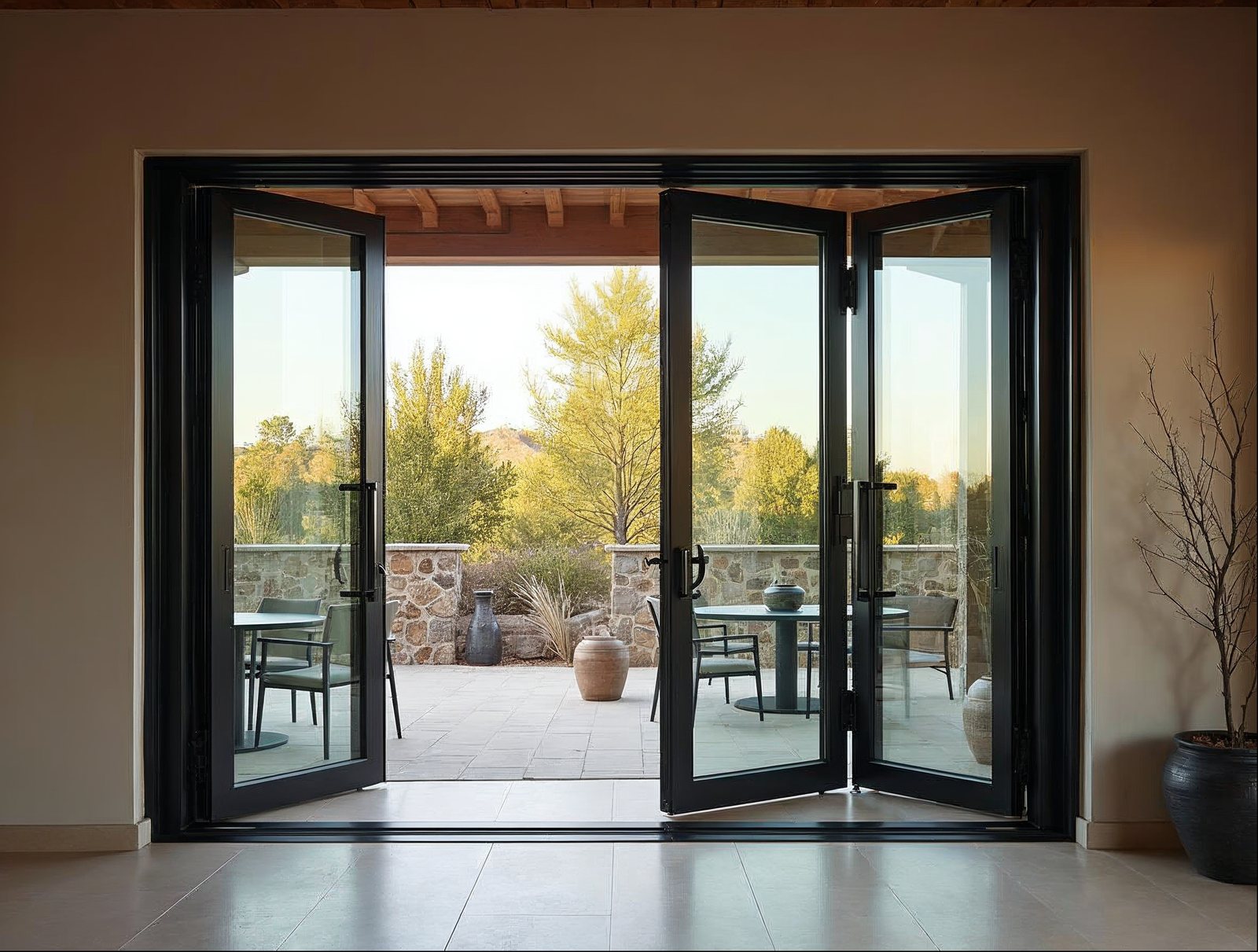
Aluminum bi-fold doors can be configured to fold inward, outward, or — in a split-fold layout — both directions simultaneously. The choice is determined by your slab depth, interior clearance, exterior deck or threshold conditions, and personal preference.
- Outward fold: Panels swing toward the exterior. This keeps interior floor space completely clear and is the most common choice for residential patio applications where there is an open deck or patio to receive the folded stack.
- Inward fold: Panels swing toward the interior. Useful when an exterior overhang, screen enclosure, or landscape feature limits outward swing. Requires adequate interior clearance for the folded panel stack depth.
- Split fold (traffic door center): The panel run splits at the center, with half folding left and half folding right. This is ideal for very wide openings — 20 feet or more — because it reduces the folded stack depth at each end and creates a centered traffic door for daily entry and exit without opening the entire system.
The direction of fold affects threshold design as well. Outward-folding systems can use a low-profile sill with a flush or near-flush interior threshold, which is better for wheelchair accessibility and for eliminating trip hazards in high-traffic spaces. Confirm your preferred fold direction before ordering so the hinges, seals, and track are configured correctly at the factory.
Can large bi-fold doors have screens added to them?
Yes, screens can be added to aluminum bi-fold door systems, though the mechanism differs from a standard sliding screen door. Because bi-fold panels fold and stack rather than slide in a fixed plane, conventional fixed screen tracks do not work. The two main screen solutions for large bi-fold openings are retractable roll screens and separate sliding screen panels.
- Retractable roll screens: These mount to the header and roll up into a cassette when not in use. They can span very wide openings and are nearly invisible when retracted. They are the most popular screen solution for large bi-fold systems because they do not interfere with the folding panels at all.
- Sliding screen panels: A separate screen track — installed inside the bi-fold track system — carries individual screen panels that slide independently of the folding doors. These are more robust for high-traffic openings but add complexity to the frame and sill assembly.
Screen compatibility should be confirmed at the time of ordering, not retrofitted after installation. The frame and track assembly needs to be dimensioned to accommodate whichever screen system you choose. Mention your screen requirement when you configure your system so the rough opening and header dimensions can account for the additional hardware.
For spaces where ventilation is just as important as the view, also consider folding passthrough windows — a compact complement to bi-fold doors that opens a kitchen or bar counter to an outdoor serving area with its own screen-compatible folding system.
What should I know before deciding if bi-fold doors are worth the investment?
Bi-fold doors are worth the investment when your project genuinely benefits from a wide, unobstructed opening and you are prepared to plan the installation correctly. Here is an honest breakdown of the key decision factors.
Cost vs. long-term value
Aluminum bi-fold door systems cost more upfront than standard sliding patio doors, but they serve a functionally different purpose — full wall elimination, not just a large glass panel. The right comparison is with other architectural wall-opening systems, not with entry-level patio doors. Factory-direct pricing from Gladiator removes the dealer margin that is built into dealer-network brands, which typically adds 20–40% to the retail price. Free nationwide shipping is included on all Gladiator systems, which matters significantly on large, heavy door orders.
Energy performance
Thermal-break aluminum frames with insulated glass units (standard 6mm glass, dual-pane configurations available) deliver whole-door NFRC U-factors that meet or exceed energy code requirements in most U.S. climates, including California Title 24. Larger glass areas magnify the impact of glass specification choices — low-e coatings and argon-filled cavities are worth specifying on any large bi-fold system, especially for south- or west-facing exposures.
Lead time and ordering
Standard-size bi-fold configurations ship faster from stock. If your project is on a tight timeline, check Gladiator's in-stock doors ready to ship before committing to a custom order. Custom widths and finishes are available but carry a longer production lead time — factor this into your construction schedule.
What bi-fold doors do best
They excel at: large residential patio and pool openings, restaurant and hospitality indoor-outdoor dining walls, covered outdoor living rooms under aluminum pergolas, and any project where the design goal is erasing the boundary between inside and outside. For openings under 10 feet where full-wall elimination is not the goal, a premium sliding glass door may deliver similar visual openness at a lower price point — and that is the honest answer.
Pairing with other systems
Many architectural projects combine bi-fold doors on the main living wall with a statement pivot door at the primary entry — using the pivot for arrival drama and the bi-fold for everyday indoor-outdoor living. These systems can be ordered in matching finishes for a cohesive exterior palette.
If you are a builder, contractor, or architect specifying multiple units, Gladiator's reseller and wholesale program offers project pricing and dedicated support. Ready to configure your system? Browse Gladiator bi-fold doors or reach out to our team for a free consultation — no pressure, just answers.


