


 904-822-1078

Can large sliding glass doors come with blinds built inside the glass?
Yes — integrated blinds or shades can be factory-sealed between the two panes of an insulated glass unit (IGU), giving you light control without any exposed hardware, cords, or dust accumulation. The blind or shade mechanism sits in an inert argon- or air-filled cavity, controlled by a slim magnetic slider on the glass face or a low-profile handle at the sill. This technology, often called "between-glass" or "integral-blind" glazing, is available as an upgrade on select sliding door configurations.
The important caveat is scale. Standard between-glass blind systems are engineered for panel widths up to roughly 36–48 inches. On a wide-opening large sliding glass door — think a 12-foot, 16-foot, or 20-foot multi-panel system — each individual panel may qualify, but the total opening requires one blind cassette per panel. That means your light and privacy control is panel-by-panel rather than a single sweeping shade across the full width, which affects both aesthetics and usability.
Thermally broken aluminum frames, which are standard on architectural-grade sliding systems, are compatible with integral-blind glass units. The blind cassette is specified at the glass order stage, so it cannot be retrofitted after the IGU is manufactured — this is a decision you lock in before the door ships.
What are the pros and cons of internal blinds in a large sliding patio door?
Internal blinds deliver genuine advantages in durability and low maintenance, but they carry trade-offs in cost, repairability, and design flexibility that every buyer should weigh before committing.
Advantages
- Zero dust accumulation. Because the blind sits inside a hermetically sealed unit, it never needs cleaning — a meaningful benefit for wide doors that are hard to reach across.
- No cords or wands in traffic zones. Child- and pet-safety concerns disappear. The magnetic or lever controller sits flush on the glass surface.
- Streamlined aesthetic. From both inside and outside, the glass reads cleanly. There are no valances, brackets, or fabric panels interrupting the view.
- Protected operation. The blind cannot be bent, tangled, or damaged by foot traffic past the door — a real consideration on a heavily used patio opening.
Disadvantages
- Panel-by-panel control only. On a 4- or 6-panel slider, you adjust each panel independently. There is no single-pull that closes shade across the full opening simultaneously.
- Limited shade options. Built-in systems typically come in venetian (horizontal slat) or a basic honeycomb. Roller sheer, blackout fabric, or solar-screen weaves in a wide range of opacities are generally not available as integral options.
- Sealed-unit repair cost. If the IGU seal fails or the blind mechanism breaks, the entire glass unit must be replaced — not just the blind. For large panels, this is a significant expense.
- Thermal performance nuance. The blind adds a thermal layer, but it also occupies the cavity that normally holds argon gas. Verify U-factor and Solar Heat Gain Coefficient (SHGC) ratings on the specific unit — especially relevant if you are designing for California Title 24 energy compliance.
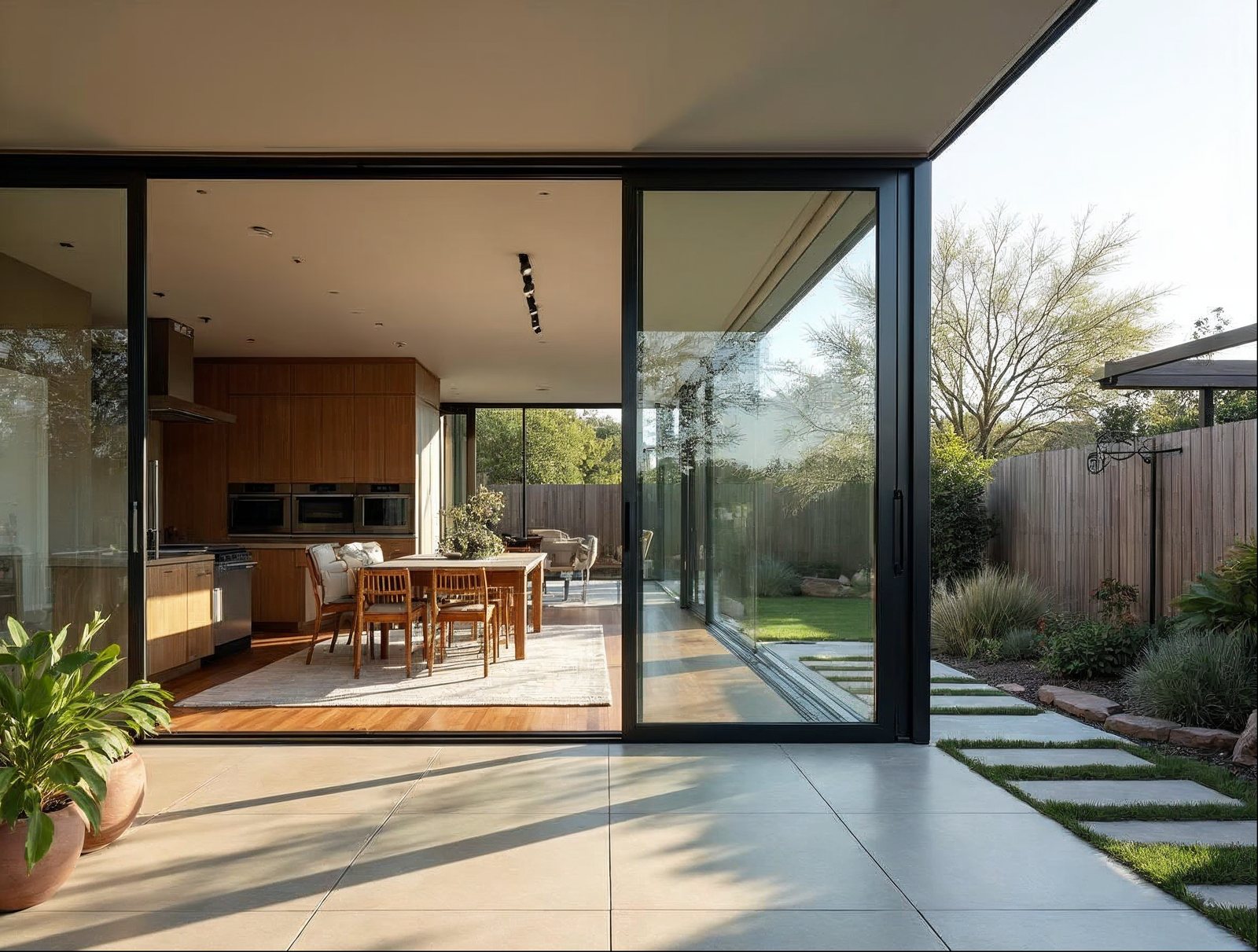
What window covering options work best for large sliding glass doors — blinds, shades, shutters, or curtains?
For wide patio openings, the best window covering is usually the one that stacks most compactly when open, operates reliably at scale, and complements the door's architectural character. Here is a practical breakdown:
| Covering Type | Best For | Drawback at Large Scale |
|---|---|---|
| Between-glass blinds | Low-maintenance, clean look, child safety | Panel-by-panel only; sealed-unit replacement if damaged |
| Motorized roller shades | Full-width single drop; blackout or solar-screen options | Requires ceiling pocket or bulkhead; motor maintenance |
| Vertical blinds | Budget-friendly; easy to stack to one side | Can look dated; difficult to fully conceal when open |
| Bi-fold panel shutters | High-end look; total light block when closed | Requires significant stack space; custom fabrication lead time |
| Floor-to-ceiling curtains | Soft, residential warmth; color and texture variety | Bulky stack-back; can interfere with door operation if rod is too close |
| Solar shades (exterior) | Glare reduction while preserving outward view | Wind exposure; motorization recommended for wide spans |
For most wide-opening sliding glass doors, motorized roller shades in a ceiling-recessed pocket deliver the best combination of clean aesthetics, full-width operation, and light-control versatility. They operate as a single unit regardless of door width and can be programmed to schedules or tied to smart-home systems.
If you want a purely architectural look with no visible hardware, consider pairing your slider with an aluminum pergola system outside — louvered roof blades let you manage sunlight at the source before it even reaches the glass.
How do you hang curtains or shades on an oversized sliding glass door?
The key principle is to mount hardware wide of the door frame and high enough so that fabric stacks entirely off the glass when the door is open. Here is exactly how to plan it:
Curtain Rod Placement
- Width: Extend the rod 12–18 inches beyond each side of the door frame. On a 16-foot door, that means a rod spanning roughly 19–20 feet. This allows full panels to clear the glass completely when stacked open.
- Height: Mount the rod as close to the ceiling line as possible — ideally within 2–4 inches. Floor-to-ceiling curtains visually elongate the opening and make even a standard 8-foot ceiling feel taller.
- Panel count: Use four or more panels (not two) on wide doors so the fabric stack on each side stays manageable and doesn't block sidelights.
- Track systems: For spans over 10 feet, a ceiling-mounted curtain track outperforms a tension rod. Tracks rated for heavy fabric are available in continuous runs and allow smooth, quiet operation.
Shade or Blind Installation
- Ceiling pocket: The cleanest approach. A recessed pocket (typically 4–6 inches deep) hides the shade tube and motor completely. Plan this during the rough-framing stage — retrofitting a pocket into a finished ceiling is expensive.
- Surface-mounted fascia: If a pocket isn't feasible, a wide aluminum fascia board conceals the roller and brackets. Match it to your door frame finish for a cohesive look.
- Clearance from the door: Always leave at least 2 inches between the bottom of the roller housing and the top of the door frame so the shade drops without catching the frame. For exterior shades, verify that screen tracks do not conflict with the door's slide path.
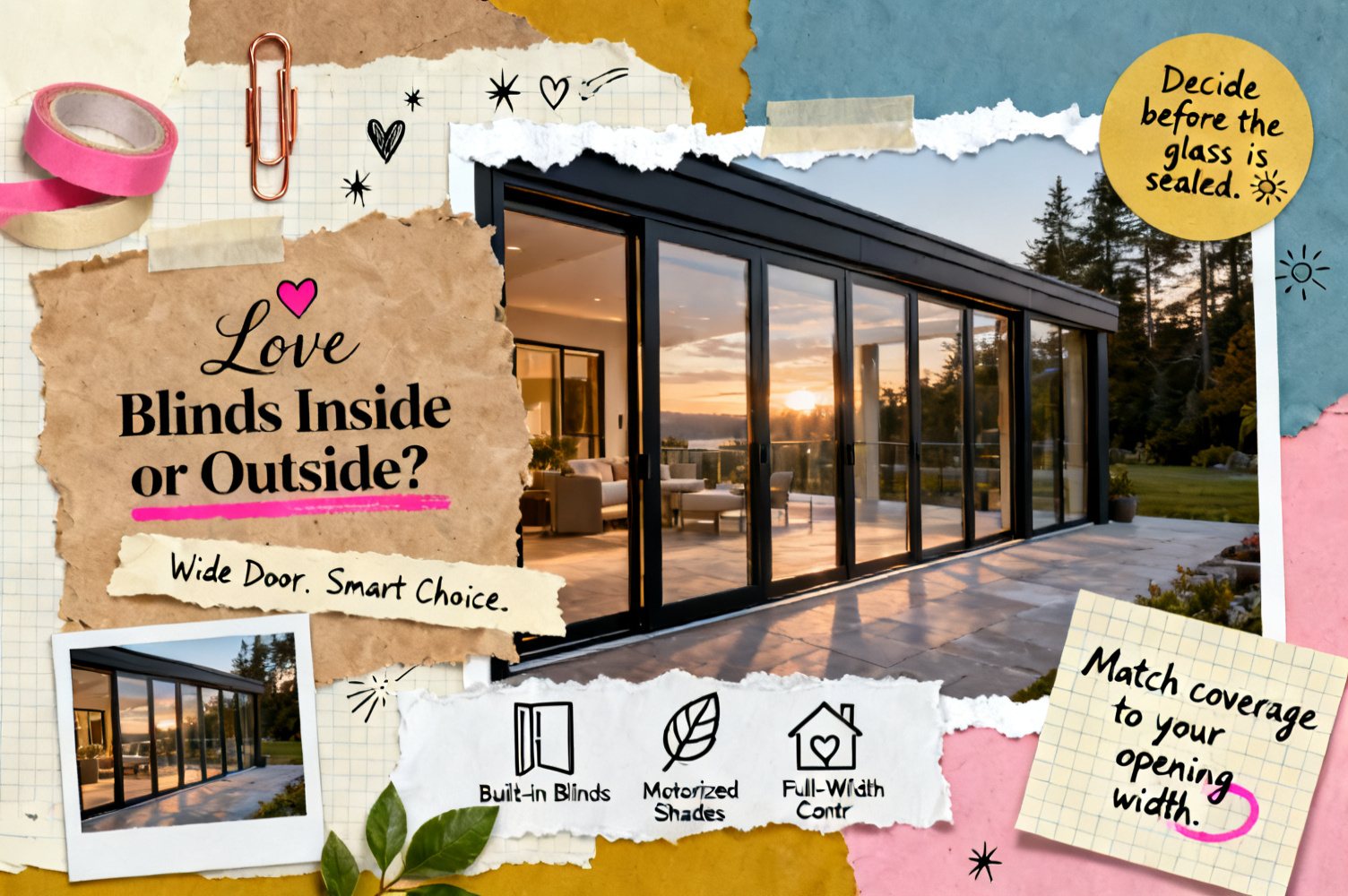
Are sliding glass doors with built-in shades more expensive than standard large sliding doors?
Yes — between-glass blind or shade units carry a meaningful premium over standard clear or Low-E insulated glass, and the cost scales with panel count. Here is a realistic framework:
- Glass unit upcharge: Integral-blind IGUs typically add $150–$400 per panel over a comparable Low-E unit, depending on the blind type and panel size. A 4-panel door system could add $600–$1,600 to the glass cost alone.
- Labor is unchanged: Installation complexity is essentially the same — the blind is factory-sealed, so there is no extra on-site work.
- Comparison point: A high-quality motorized roller shade system for a 16-foot opening — hardware, motor, smart controller, and professional installation — typically runs $800–$2,500 depending on fabric and motor brand. That range overlaps with the between-glass premium, so cost alone is rarely the deciding factor.
- Long-term cost of ownership: Built-in blinds win on maintenance (no cleaning, no replacement parts for years). External shades win on repairability — if a motor fails, you replace the motor, not a $600 glass panel.
For buyers who value a low-maintenance, uncluttered look and are ordering a standard panel count, the integral-blind upgrade is a reasonable investment. For maximalist openings — 20 feet or wider with 6-plus panels — a ceiling-integrated motorized shade system is usually more practical and comparable in total cost.
If you're still sizing your opening, check our in-stock doors ready to ship — standard configurations are available for faster delivery, and the product pages show current pricing so you can compare options without a quote call. Builders and architects sourcing at volume can also explore our reseller and wholesale program for further savings.
The Bottom Line
Large sliding glass doors with blinds built inside the glass are a genuinely useful upgrade for the right buyer — particularly those who prioritize low maintenance, clean aesthetics, and child safety. For very wide openings or buyers who want blackout capability or complex light-control schedules, an external motorized shade system offers more flexibility at a comparable or lower total cost. The best approach is to decide on your covering strategy before the door is ordered, since between-glass blinds cannot be added after the glass unit is sealed.
Ready to spec your door? Browse our full line of large sliding glass doors and configure your panel count, finish, and glass package — or explore complementary systems like bi-fold doors if a fully open wall is the goal.


