


 904-822-1078

What sizes do large aluminum pivot front doors come in for residential projects?
Large aluminum pivot front doors for luxury residential projects typically range from 42 inches to 72 inches wide and 8 feet to 14 feet tall as a single slab, with overall system widths — including sidelites — reaching 12 to 20 feet or more. Because a pivot door rotates on a top-and-bottom pivot point rather than a side hinge, there is no practical structural limit tied to frame width. The door slab itself carries the load through its own axis, which is why oversized slabs that would sag or bind on a conventional hinge work effortlessly on a pivot.
Common residential pivot door slab widths and heights include:
- 42" × 96" — a confident upgrade over a standard entry, works in most existing rough openings with minimal modification
- 48" × 108" — the most popular luxury-home starting point; visually commanding without requiring a full header rebuild
- 60" × 120" — a true statement entry; requires a structural header and is typically specified new-construction or full-remodel
- 72" × 144" — grand-scale, often paired with floor-to-ceiling sidelites; common on estate homes and architect-designed custom builds
Standard sizes are kept in stock at our warehouses and ship significantly faster than custom-order slabs — if you have a common rough opening, check our in-stock doors ready to ship for the fastest lead time. Custom dimensions are also available for projects that require a non-standard height or width.
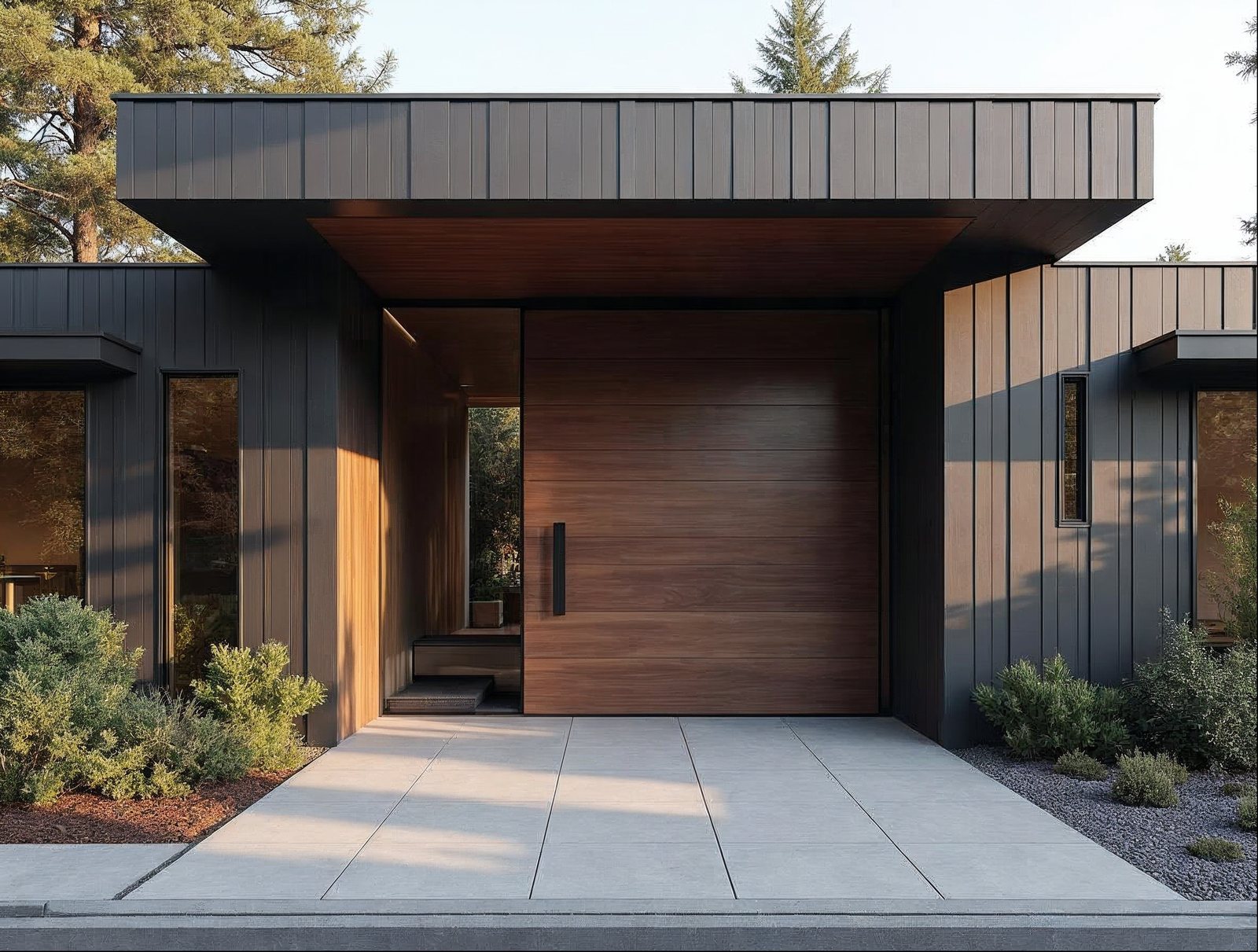
What makes a pivot door different from a standard hinged entry door — and is it right for my home?
A pivot door rotates on a vertical axis set inward from the door's edge — usually offset 6 to 12 inches from the stile — rather than swinging from a side-mounted hinge. This single mechanical difference unlocks three things that a conventional hinged door cannot do: dramatically larger slab sizes, a floating, symmetrical visual composition, and a tactile swing motion that feels entirely unlike a standard door.
Here is how the two systems compare on the factors that matter most to luxury homeowners:
| Factor | Standard Hinged Entry Door | Aluminum Pivot Door |
|---|---|---|
| Maximum practical slab width | ~42 inches (beyond this, hinge stress causes sag) | 72 inches or more — no sag limitation |
| Maximum slab height | ~96 inches standard; taller requires heavy hinges | Up to 144 inches (12 ft) routinely achieved |
| Frame weight distribution | Carried entirely by the hinge-side jamb | Distributed through top and bottom pivot hardware into the floor and header |
| Visual impression | Traditional; recedes into the facade | Architectural focal point; defines the home's identity |
| Glass area possible | Limited by frame stiffness | Near full-height glass panels achievable |
| Hardware visibility | Hinge barrels visible on the exterior | Concealed pivot mechanism; clean, hardware-free face |
A pivot door is right for your home if you want your entry to make an unmistakable architectural statement, if your opening is wider or taller than a conventional hinge system can handle gracefully, or if you simply want the tactile experience of a door that moves with effortless, balanced momentum. Browse our full collection of residential pivot doors to see the range of configurations available.
How much does a large pivot front door cost for a luxury residential entry?
A large aluminum pivot front door for a luxury home typically costs between $4,000 and $18,000+ depending on slab size, glass type, finish, and hardware selection — before installation. Because Gladiator sells factory-direct with no dealer or showroom markup, our pricing delivers a significant value advantage over dealer-network brands at equivalent specifications.
The primary cost drivers are:
- Slab size — the single biggest factor; a 72" × 144" slab involves substantially more aluminum extrusion and glass area than a 48" × 96" slab
- Glass specification — standard 6mm tempered clear glass is included; upgrades to low-e coatings, laminated glass, or patterned/frosted glass add cost
- Finish — powder-coat finishes (matte black, white, bronze anodized, RAL custom colors) carry different upcharges; standard colors cost less than specialty RAL matches
- Hardware — a minimal pull bar costs far less than a solid-brass, full-height lever system with electronic locking
- Sidelites and transoms — adding fixed glass panels on either side of the pivot slab increases the system price but maximizes visual impact
- Lead time — in-stock standard sizes ship faster and sometimes carry a lower price point; custom sizes have longer production windows
Free shipping to all 50 states is included, which meaningfully offsets total project cost compared with brands that charge freight separately.
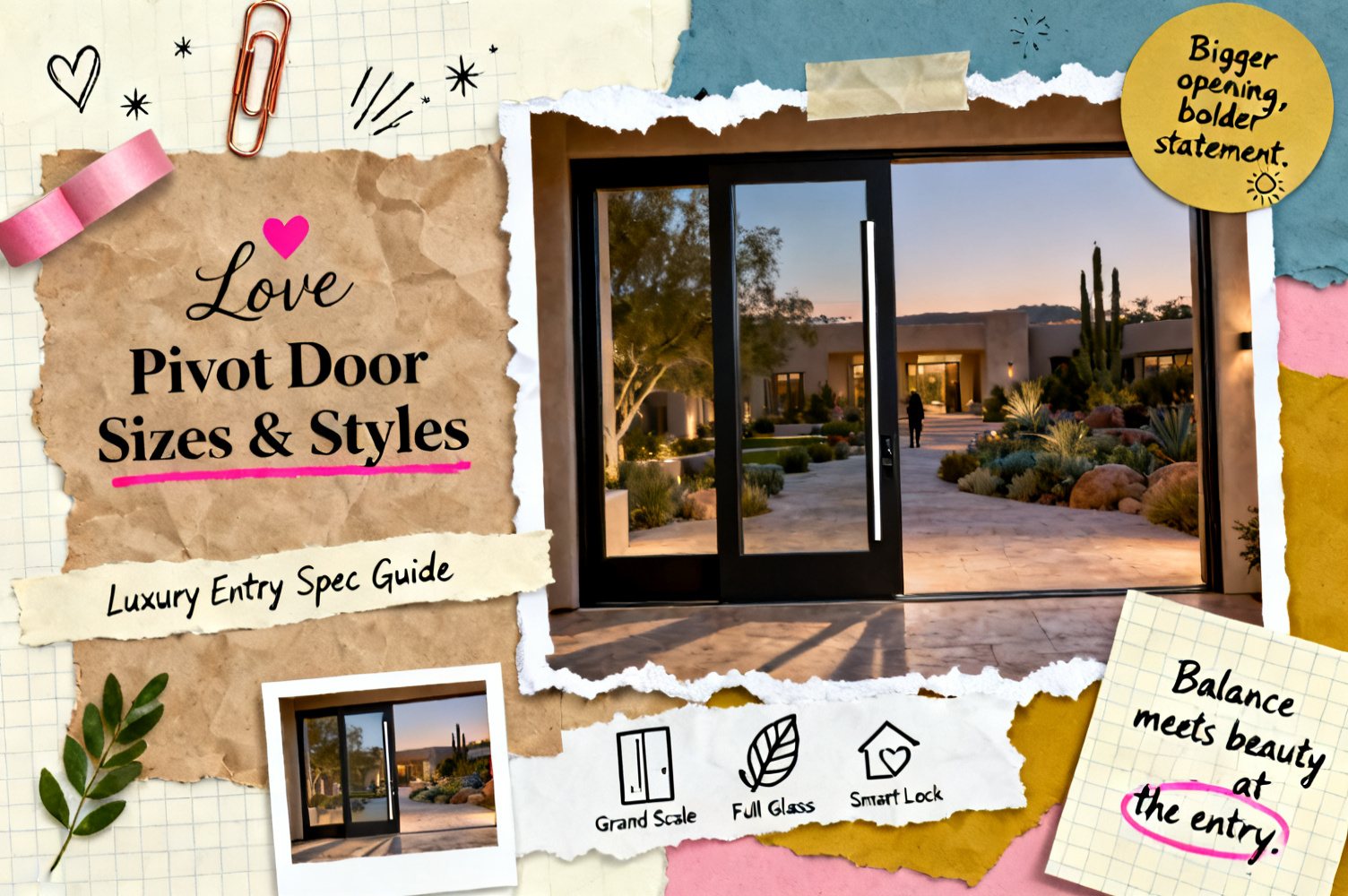
What glass and finish options are available for oversized pivot doors?
Gladiator aluminum pivot doors are available with a wide range of glass and finish combinations, allowing the door to anchor any architectural language — from raw industrial to warm coastal contemporary.
Glass Options
- 6mm tempered clear — the standard specification; strong, optically clean, and thermally superior to thinner glazing common in entry-level systems
- Low-E double-glazed insulating units — recommended for California Title 24 compliance and any climate where thermal performance is a priority; significantly reduces heat gain and U-factor
- Laminated interlayer glass — adds an inner PVB layer for safety and acoustic attenuation; popular in urban settings and high-traffic neighborhoods
- Frosted / satin glass — provides privacy at the entry while still allowing diffuse light to flood the foyer
- Patterned art glass — reeded, fluted, or textured panels for a designer aesthetic
- Tinted glass — bronze, grey, or blue tints that complement specific exterior palettes
Finish Options
- Matte black — the most requested finish for contemporary and transitional luxury homes; pairs with almost every cladding material
- Dark grey RAL 7016 — softer than matte black, works beautifully on light-colored facades
- White RAL 9010 — crisp and clean; ideal for coastal, Scandinavian, and farmhouse modern aesthetics
- Bronze anodized — a warm metallic tone with excellent long-term durability; no paint layer to chip or fade
- Custom RAL powder coat — virtually any color in the RAL spectrum is available for projects with a specific exterior color story
The aluminum extrusion profiles on our pivot doors are thermally broken, meaning the interior and exterior aluminum faces are separated by a polyamide thermal barrier — this prevents condensation on the inside face and significantly improves whole-door energy performance.
What handle and hardware options work best for a giant pivot door?
For an oversized pivot door, hardware must be proportional to the slab and engineered to manage the door's mass — a small lever handle that works on a 36-inch entry door looks visually lost and feels physically awkward on a 60-inch pivot slab. The best-performing and best-looking hardware options for large pivot doors fall into three categories:
- Full-height pull bars — a continuous vertical bar running most of the door height (often 48 to 72 inches of pull surface). These are the defining hardware look for architectural pivot doors: simple, structural, and proportionally correct. Available in stainless steel, matte black, and brushed brass.
- Half-height architectural pulls — a shorter bar (typically 24 to 36 inches) centered at grip height. More restrained than a full-height bar; pairs well with doors that have heavy glass fractions where a full bar would obscure the view.
- Integrated flush pulls with electronic locking — for a truly minimal look, flush pulls recessed into the stile eliminate any protruding hardware. Combined with a smart lock or motorized latch, these create a completely seamless face — no visible mechanism at all from the exterior.
Multi-point locking is standard on Gladiator pivot doors — the locking mechanism engages at multiple points along the door height, distributing seal pressure evenly and eliminating the racking and air infiltration common with single-point latches on tall slabs. For smart-home integration, electronic deadbolt and access-control options are available. Matching pivot door hardware to your overall exterior metalwork — whether that is matte black window frames, bronze light fixtures, or stainless door numbers — creates a cohesive, designed entry sequence.
How do I know if my entryway opening is large enough for a pivot door system?
Your rough opening dimensions determine which pivot door configurations are feasible without structural modifications — and in many cases, existing openings in luxury homes are already large enough for a commanding pivot installation. Here is how to evaluate yours:
- Measure the rough opening width — the clear distance between framing studs or masonry reveals. A pivot door system (slab + frame) typically requires 2 to 4 inches of frame clearance on each side, so a 54-inch rough opening comfortably accepts a 48-inch slab.
- Measure the rough opening height — floor to the underside of the structural header. Pivot doors need a floor-to-header clear height equal to the door height plus the bottom pivot floor box depth (typically 1 to 2 inches recessed into the floor) plus the top pivot housing (typically 1.5 inches).
- Check the header capacity — a large pivot slab transfers its weight through the top pivot into the header above the opening. For slabs over 500 lbs (common above 60" × 120"), confirm with your structural engineer that the existing header or lintel is adequate, or plan for a new LVL or steel header.
- Assess the floor at the pivot point — the bottom pivot requires a solid, rigid substrate. Concrete slabs are ideal. Wood subfloors over crawlspaces may need blocking reinforcement directly below the pivot bearing point.
- Consider swing clearance — because a pivot door rotates on an offset axis, the rear edge of the slab swings inward (into the foyer) when the door opens. Plan for at least 12 to 18 inches of unobstructed clearance behind the pivot point in the direction of swing.
If your current opening is smaller than your desired door size, expanding it is a standard part of many luxury remodel projects — your general contractor or structural engineer can assess header replacement costs. For new construction, sizing the rough opening to your pivot door specification from the start is always the most cost-effective path.
Not sure where to start? Our team can walk you through sizing for your specific project. And if you are comparing door systems for a larger project — perhaps pairing a pivot entry with folding bi-fold doors at a rear living space or multi-slide sliding glass doors on a terrace — we can help you spec the full package. Builders and architects working across multiple projects may also want to explore our reseller and wholesale program.
Ready to design your entry? Explore our full range of large pivot front doors, check in-stock sizes available to ship now, or reach out to our team for a no-pressure sizing consultation.


