


 904-822-1078

The short answer: a large aluminum pivot front door can reach 5 ft wide × 12 ft tall as a single slab — and much larger when configured as a pivot slab flanked by fixed sidelites or transom panels. For commercial and high-end residential entries, pivot systems routinely span 10–14 ft in total assembly width. This guide gives contractors, builders, architects, and dealers the dimensional, hardware, and specification detail they need to plan, quote, and order a large pivot door with confidence.
By the Gladiator Window & Doors technical content team — a factory-direct source for custom aluminum pivot, sliding, bi-fold, and storefront systems shipped to all 50 states.
1. What Are the Standard and Maximum Dimensions for a Large Pivot Front Door?
Standard aluminum pivot doors begin at roughly 36 in. × 80 in. (3 ft × 6 ft 8 in.) — but the category's real design appeal starts at 42 in. wide and 96 in. tall, where the slab's mass and presence become architecturally significant. Below is a practical breakdown of the size tiers most relevant to trade buyers.
| Size Tier | Slab Width | Slab Height | Typical Application |
|---|---|---|---|
| Standard | 36–42 in. | 80–96 in. | Residential entry replacement |
| Large Residential | 42–54 in. | 96–120 in. (8–10 ft) | Luxury home, modern entry statement |
| Oversized Residential | 54–60 in. | 120–144 in. (10–12 ft) | Estate, custom-build, tall-ceiling foyer |
| Commercial / Monumental | Up to 60 in. | Up to 144 in. (12 ft) | Hotel lobby, office entry, retail flagship |
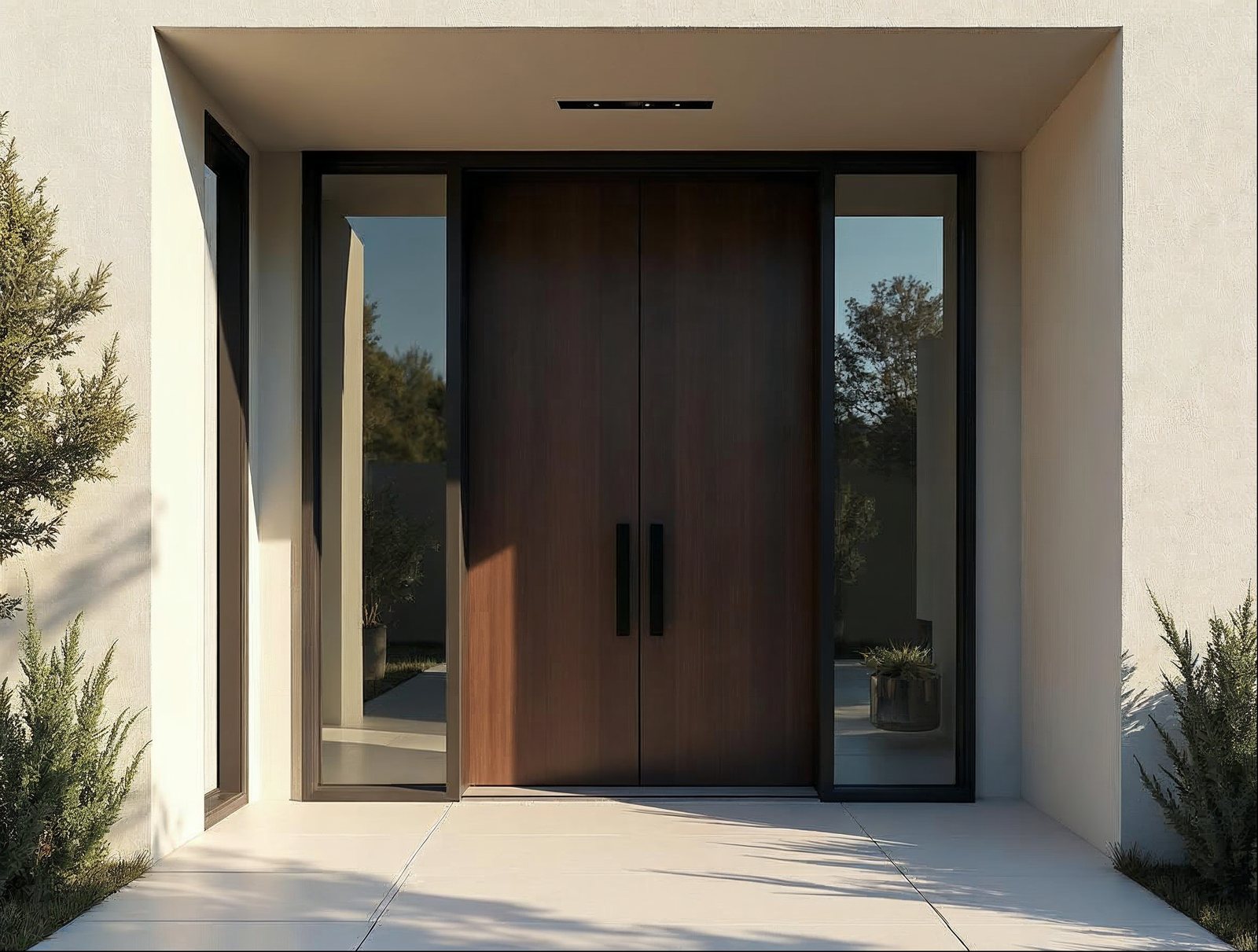
Maximum single-slab dimensions for a thermally broken aluminum pivot door are approximately 60 in. wide × 144 in. tall (5 ft × 12 ft). Beyond those limits, the slab's dead weight exceeds what a single pivot mechanism can carry safely without bespoke engineered hardware. Total opening width can be extended further by adding fixed sidelite panels on one or both sides of the pivot slab, achieving clear visual widths of 12–18 ft or more within a single frame system.
Glass area note: Gladiator pivot doors are glazed with 6 mm tempered or laminated glass as standard — heavier than the 4–5 mm glass common in lower-tier systems, which matters significantly for slab weight calculations and pivot-point load ratings.
2. How Big Can a Pivot Door Realistically Be for a Residential or Commercial Entry?
For most residential projects, a pivot slab of 48 in. wide × 108–120 in. tall (4 ft × 9–10 ft) is the practical sweet spot — large enough to make a strong architectural statement, while remaining within standard pivot hardware load ratings and manageable rough-opening sizes. Here is what realistically constrains maximum size:
- Slab dead weight: A 60 in. × 144 in. slab with 6 mm glass and a thermally broken aluminum frame can weigh 400–650 lb depending on glass unit type (single, double, triple). The pivot bearing must be rated to handle this continuously.
- Header depth and structural load path: Oversized pivot slabs require a substantial structural header — often a steel or LVL beam — to transfer loads around the opening. This is a rough-opening planning item, not just a door spec.
- Swing clearance: A pivot door rotates on a point set inward from the leading edge, so a 60 in. slab sweeps a large interior arc. Interior furniture placement and floor finishes must account for this geometry.
- Ceiling height: A 10 ft or 12 ft slab requires ceiling heights that clear the door head plus the frame head, typically meaning finished ceiling heights of 11 ft or 13 ft minimum to allow standard frame head clearance and reveal.
For commercial entries — hotel lobbies, office buildings, retail flagships — 54–60 in. slabs at 108–144 in. tall are entirely routine. These applications often pair the pivot slab with fixed sidelites and a transom panel to achieve a full-width glass wall effect at the entry. Gladiator's aluminum pivot door collection covers both residential and commercial scale in thermal-break aluminum with factory-direct lead times.
3. What Hardware Is Required for an Oversized Pivot Door and How Is It Specified?
Oversized pivot doors demand a floor-and-ceiling pivot bearing system rated to the slab's actual dead weight — specifying by door "size" alone is insufficient and is the most common source of field problems. Here is how to specify correctly:
Pivot Bearing Rating
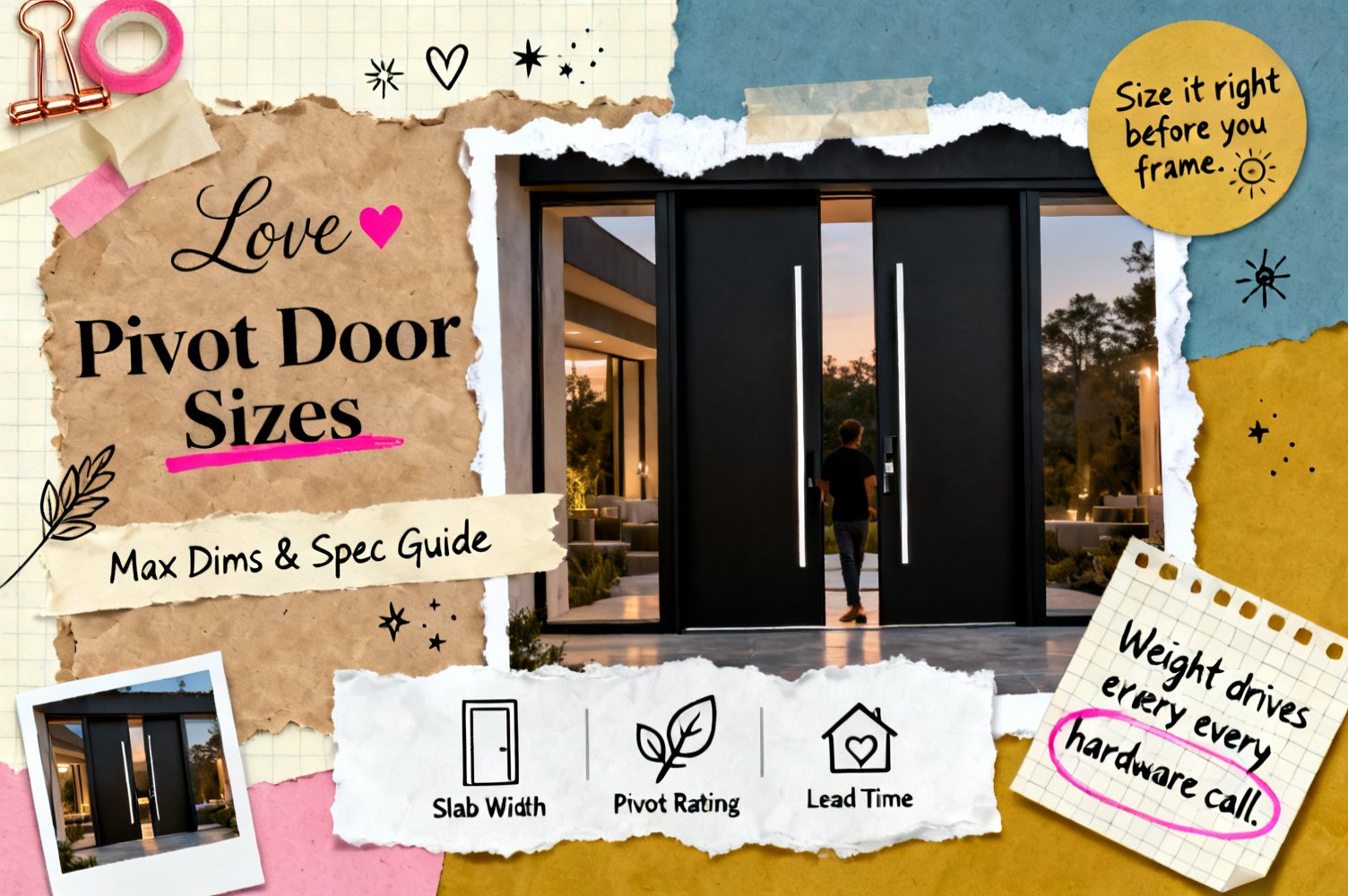
Pivot hardware is rated by weight capacity in pounds (or kg), not by door size. For large residential slabs (200–400 lb), a heavy-duty pivot set rated to at least 500 lb provides appropriate safety margin. Monumental commercial slabs above 400 lb require engineering-grade pivot systems rated to 800–1,200 lb. Always calculate actual slab weight before specifying hardware — glass type (DGU vs. triple-glazed), frame profile depth, and slab area all factor in.
Floor Pivot vs. Fully Concealed Pivot
- Floor pivot (exposed patch fitting): Most common for large residential slabs. The floor pivot plate is surface-mounted on the finished floor; the top pivot fits into the frame head. Load path is clear and serviceable.
- Fully concealed pivot: Both top and bottom bearings are recessed — zero visible hardware. Preferred for monumental or design-forward entries. Requires precise structural blocking in the floor slab and frame head. Heavier engineering coordination but achieves a floating-slab visual effect.
Specifying the Pivot Offset
The pivot offset — the horizontal distance from the door edge to the pivot centerline — determines the balance between the inswing arc (smaller) and the outswing arc (larger). A standard offset is 4–6 in. from the leading edge, leaving roughly 90% of the slab width sweeping into the interior. For very wide slabs (54–60 in.), a larger offset of 8–12 in. can reduce the interior arc, which matters in tight foyers.
Locking and Access Control
Large pivot doors require multipoint locking systems compatible with the slab height. For slabs over 96 in., a three-point lock (top, center, bottom) is standard. Smart-lock and access-control integration is increasingly specified on commercial and high-end residential pivots — coordinate this at the door-order stage, not during installation.
4. How Does a Large Pivot Door Differ from a Standard Entry Door in Construction Details?
A large aluminum pivot door is structurally and mechanically different from a conventional hinged entry door in almost every dimension — and trade buyers who specify pivot doors for the first time need to understand these differences to avoid costly RFIs and change orders.
Frame and Slab Construction
Gladiator pivot doors use thermally broken aluminum extrusions — two aluminum profiles separated by a polyamide thermal break — which dramatically reduces conductive heat transfer through the frame. This is not cosmetic: on large-format slabs with expansive glass areas, frame thermal performance meaningfully affects the whole-door NFRC U-factor, which matters for California Title 24 energy compliance and comparable state energy codes.
The slab itself is a rigid aluminum perimeter frame, internally reinforced at corners, enclosing a double-glazed insulated glass unit (IGU) with 6 mm outer pane as standard. Laminated glass upgrades are available for added safety performance on monumental slabs. The slab perimeter profile is typically 2–3 in. deep on standard residential pivots and 3–4 in. deep on oversized commercial pivots, to maintain rigidity across the full slab height.
Rough Opening and Header Planning
Unlike hinged doors, pivot doors carry the slab's load through the pivot points into the floor and ceiling/header — not through side jambs. This means:
- The rough opening must be sized for the frame, not just the slab. Add 2–3 in. to each side and top for frame and shimming. For a 48 in. × 120 in. slab, plan a rough opening of approximately 54 in. × 126 in. minimum.
- The structural header above must be engineered to span the full rough opening width, as the pivot frame does not transfer horizontal loads to the side jambs the way a hinged door frame does.
- The floor at the pivot point must be structurally solid — concrete slab or blocking in wood-frame floors rated to handle concentrated point loads from a heavy slab.
- Allow for a finished floor recess if using a concealed floor pivot, coordinated with the flooring contractor before pour or finish-floor installation.
Weatherseal and Threshold
Large pivot doors use a continuous compression sweep at the door bottom and perimeter brush or compression seals on the frame. Because the slab rotates rather than slides, perimeter seals must maintain consistent contact across the full slab height. On oversized slabs, review sill and threshold height carefully: low-profile thresholds are available but must be coordinated with the floor pivot mechanism.
5. What Does a Large Aluminum Pivot Front Door Cost Compared to a Standard Pivot Door?
A standard aluminum pivot door (36–42 in. × 80–96 in.) in a thermally broken aluminum system is the baseline. Large-format and oversized pivot doors carry meaningful cost premiums driven by real material and engineering factors — not arbitrary upcharges. Here is an honest cost-driver breakdown relevant to trade buyers:
| Cost Factor | Standard Pivot (36–42 in. × 80–96 in.) | Large Pivot (48–60 in. × 108–144 in.) |
|---|---|---|
| Frame aluminum extrusion weight | Base | +30–60% more material by slab area |
| Glass unit (IGU) | Base (6 mm outer pane) | Larger unit = proportionally higher cost; laminated option adds further premium |
| Pivot hardware rating | Standard 300–400 lb pivot set | Heavy-duty 500–1,200 lb rated pivot set — meaningful cost step-up |
| Locking system | Single- or two-point lock | Three-point multipoint lock required above 96 in. slab height |
| Finish | Powder coat (matte black standard) | Same options; larger surface area = higher powder coat cost per door |
| Freight | Standard crated shipment | Oversized freight; Gladiator ships free nationwide on qualifying orders |
| Lead time | In-stock standard sizes ship fast; custom 4–8 weeks typical | Custom large-format: 6–10 weeks typical; confirm at order |
Factory-Direct Trade Pricing Advantage
Dealer-network brands layer distributor and showroom margins into every oversized door quote — by the time an oversized pivot reaches a contractor or developer, markups of 30–60% above direct cost are common. As a factory-direct source, Gladiator provides trade pricing without those layers. For resellers and wholesale buyers, this margin difference is especially significant on large-format and custom-sized units, where the base cost is already substantial.
Contractors and dealers who want to offer large aluminum pivot doors competitively should apply for a Reseller & Wholesale Account to access trade pricing across the full Gladiator catalog — pivot, bi-fold doors, sliding glass doors, folding passthrough windows, and commercial storefronts.
In-Stock vs. Custom Lead Times
Standard-size pivot doors are held in inventory and ship significantly faster than made-to-order units. For large-format and custom-dimension pivots, the typical production and shipping window is 6–10 weeks from order confirmation. Build this into your project schedule at the pre-construction phase, not after framing. Check in-stock doors ready to ship for the fastest-available units on current projects.
Ordering Process for Oversized Pivot Doors
To generate an accurate quote on a large or custom pivot door, have the following ready when you contact Gladiator:
- Rough opening dimensions (width × height, confirmed from structural drawings)
- Slab size target (or let us back-calculate from the rough opening)
- Swing direction (inswing vs. outswing) and pivot offset preference
- Glass specification (clear DGU, low-e DGU, laminated, tinted)
- Hardware preference (exposed floor pivot vs. fully concealed; locking spec)
- Finish (matte black, dark grey RAL 7016, white RAL 9010, or bronze anodized)
- Project timeline (installation date target so lead time can be confirmed)
Sell Gladiator doors at a wholesale price. Factory-direct aluminum sliding, bi-fold, and pivot doors — premium aluminum, 6mm glass, low-profile tracks, no upcharges, shipped nationwide. Contractors, builders, designers, and retailers get trade pricing and real support.
Apply for a Reseller & Wholesale Account · Call 904-822-1078


