


 904-822-1078

What are accordion patio doors and how are they different from bi-fold doors?
Accordion patio doors and bi-fold doors are the same product — the terms are used interchangeably in the market. Both describe a multi-panel folding door system where individual panels are hinged together and fold in a stack to one or both sides, opening up an entire wall to the outdoors. The difference you will sometimes hear is a matter of degree: "accordion" emphasizes the pleated folding motion, while "bi-fold" is the more technical product name used by architects and glazing specialists. For the purpose of this guide, we use both terms to mean the same thing.
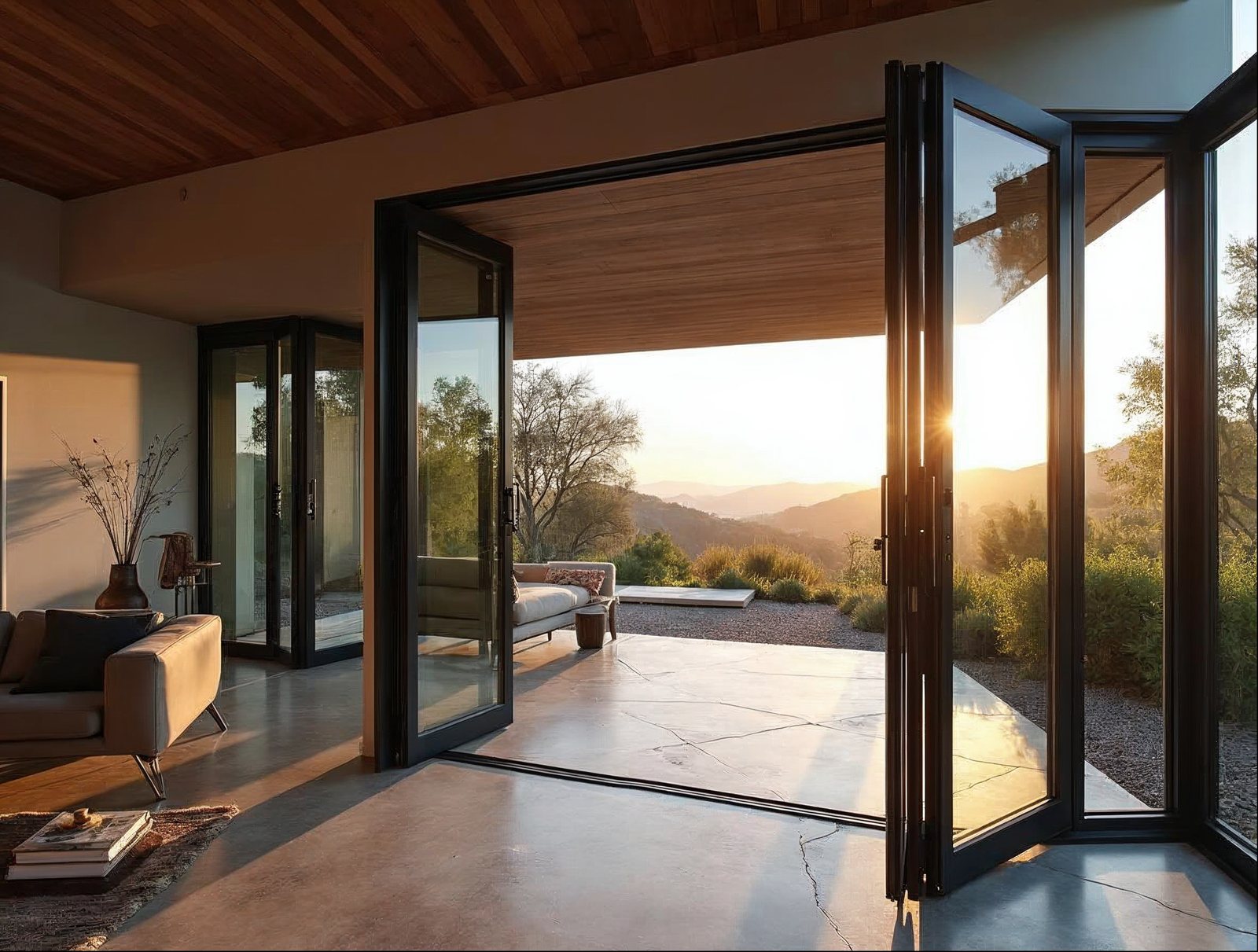
What sets folding patio doors apart from other door types is the scale of opening they create. Where a standard French door or a slider opens a portion of a wall, a bi-fold / accordion door system can completely clear a 12-, 20-, or even 32-foot opening. Panels fold flat against each other and park at the edge of the opening, leaving virtually zero structural intrusion. The result is a true merger of indoor and outdoor space — not just a view, but a full pass-through.
Gladiator's aluminum bi-fold door systems run on a low-profile recessed track, use thermally broken aluminum frames, and are glazed with 6 mm tempered glass standard. Panel counts range from 2 to 8 panels per door unit, allowing configurations that suit a modest patio addition or a full-width great-room wall.
Are bi-fold and folding patio doors worth the investment for a large opening?
Yes — for openings wider than roughly 10 feet, a bi-fold / accordion door system is almost always the most functional and visually impactful choice available, and it delivers measurable return on the investment.
Here is why homeowners consistently rate folding patio doors as worth it:
- Unobstructed sightlines: Thermally broken aluminum frames carry large glass lites with slim sight lines — far narrower than wood or vinyl alternatives — maximizing the view even when the door is closed.
- True open-plan living: No other door type opens an exterior wall as completely. Sliders leave at least half the opening covered by a fixed panel; accordion doors clear nearly 100% of the rough opening.
- Resale value: Indoor-outdoor connectivity is one of the most searched features in the premium home market. A floor-to-ceiling folding glass wall is a differentiating feature that buyers and appraisers notice.
- Energy performance: Gladiator systems carry whole-door NFRC U-factor ratings, making them code-compliant for California Title 24 and other energy codes. Thermal-break construction keeps conditioned air inside whether the door is open or closed.
- Durability: Architectural-grade aluminum does not warp, rot, or swell with humidity the way wood-clad folding systems do. A 15-year warranty backs that claim.
The honest caveat: folding patio doors cost more upfront than a basic sliding door. If your opening is under 8 feet and your priority is budget, a multi-panel sliding glass door may be the better fit. But for wide, architecturally significant openings, the bi-fold system is the superior long-term investment.
Are accordion patio doors expensive compared to sliding doors?
Accordion patio doors cost more than sliding doors at comparable widths — typically 30 to 60 percent more — but the gap narrows when you account for what each system actually delivers.
Here is a side-by-side comparison of the two systems to help frame the decision:
| Factor | Folding / Accordion Door | Multi-Slide / Sliding Door |
|---|---|---|
| Opening cleared | Up to ~95% of rough opening | 50–75% of rough opening |
| Panel count options | 2 to 8 panels | 2 to 6 panels |
| Frame material | Thermal-break aluminum | Thermal-break aluminum |
| Glass standard | 6 mm tempered | 6 mm tempered |
| Track profile | Low-profile recessed | Low-profile recessed |
| Best for opening width | 10 ft – 32 ft+ | 6 ft – 24 ft |
| Relative entry price | Higher | Lower |
| Warranty | 15 years | 15 years |
The key distinction is functional value per dollar. A sliding door that leaves half the wall covered is not equivalent to a folding door that eliminates the wall entirely. For a living room, great room, or entertainment space where the goal is a seamless indoor-outdoor connection, the extra cost of accordion doors buys a qualitatively different experience — not just a bigger opening.
Factory-direct ordering also makes a meaningful difference. Because Gladiator sells direct with no dealer markup, accordion patio doors cost considerably less than the same specification purchased through a showroom or a traditional dealer network. Free nationwide shipping is included.
What are the pros and cons of folding patio doors for exterior openings?
Folding patio doors have a strong list of advantages, but like any architectural product they involve real trade-offs. Here is an honest assessment.
Pros
- Maximum opening width: No other residential door system clears as much of a wide exterior wall. 6-panel systems routinely span 20–24 feet; 8-panel systems can exceed 30 feet.
- Design flexibility: Panels can fold to the left, to the right, or split to both sides. A traffic door (walk-through panel) can be incorporated so you do not need to open the full system for daily use.
- Slim frames, large glass: Thermally broken aluminum profiles are engineered to hold large glass lites in narrow frames, keeping sight lines architectural.
- Thermal performance: Thermal-break construction and 6 mm glass deliver NFRC-rated U-factors suitable for energy codes nationwide, including California Title 24.
- Low maintenance: Aluminum does not require periodic painting, staining, or sealing. Rinse and wipe maintenance keeps the system performing for decades.
- Factory-direct value: Ordering direct eliminates the dealer markup that inflates accordion patio door cost at traditional showrooms.
Cons
- Higher upfront cost: Compared to a sliding door, accordion doors cost more at equivalent widths. Budget planning is essential.
- Panel stack footprint: When fully open, the folded panel stack occupies wall or patio space on the stacking side. This needs to be accounted for in furniture layout and landscaping plans.
- Rough opening precision: Wide folding door systems require a precisely prepared rough opening and adequate structural header support. This is a job for an experienced installer.
- Not ideal for narrow openings: Below roughly 8 feet, a pivot door or sliding door is usually a better choice both functionally and economically. Explore pivot doors for single-opening statement entries.
How much do accordion patio doors cost for a patio or deck?
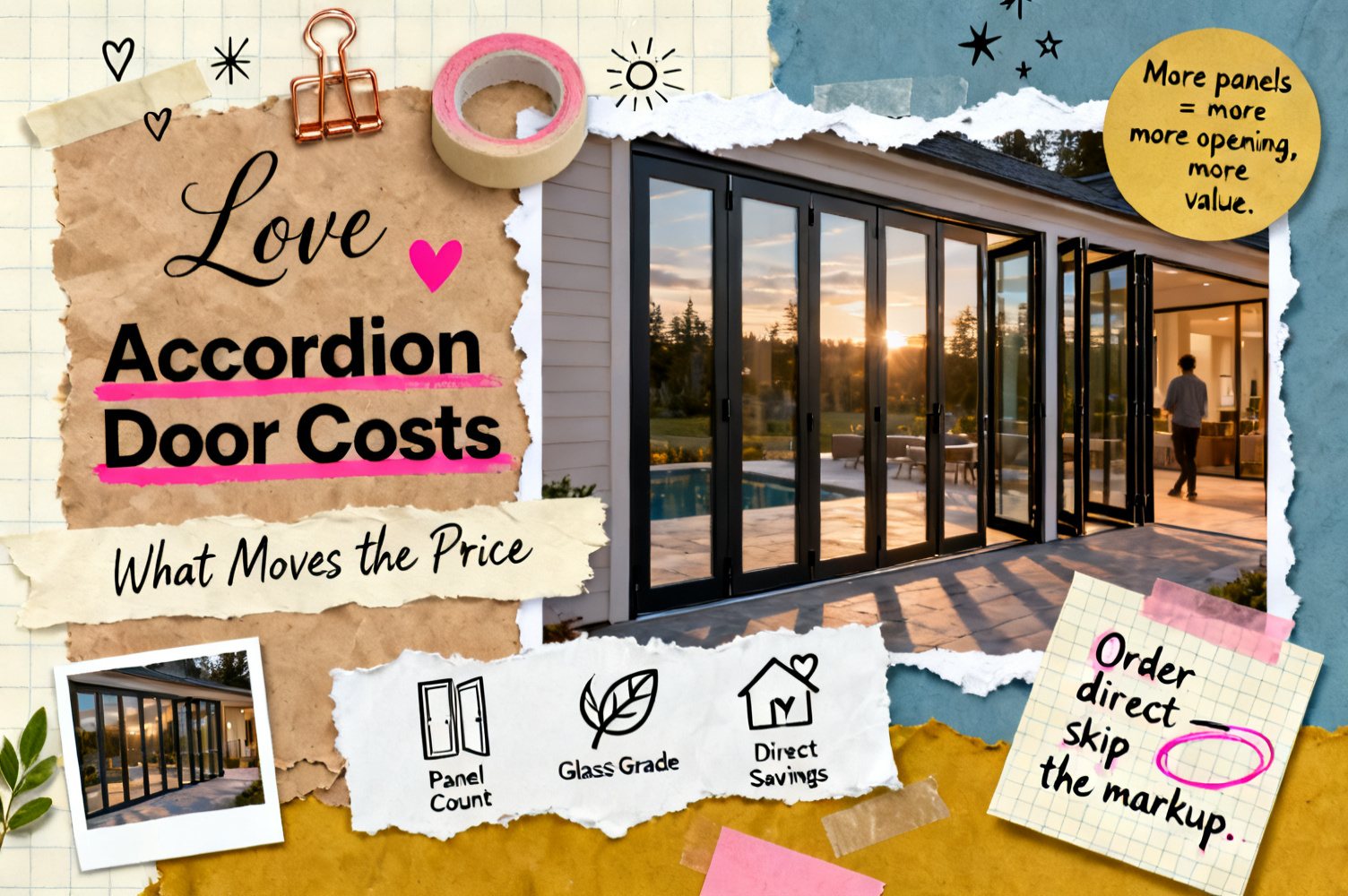
Accordion patio doors cost between approximately $3,500 and $18,000+ for the door unit alone, depending primarily on panel count, total width, glass specification, and finish — before installation labor.
Here is how the major cost drivers break down:
- Panel count and total width: This is the single biggest driver of accordion patio doors cost. A 3-panel system spanning roughly 10–12 feet starts at the lower end of the range. A 6-panel system at 20–24 feet lands in the mid-range. An 8-panel system at 30+ feet reaches the top of the range.
- Glass specification: 6 mm tempered is standard. Upgrading to double-pane insulating glass (IGU) adds cost but meaningfully improves U-factor performance — worth it for climates with significant heating or cooling seasons.
- Finish: Matte black and dark grey RAL 7016 are the most popular architectural finishes. White RAL 9010 and bronze anodized are also available. Standard finishes carry no premium; specialty powdercoat colors may add lead time.
- Configuration: A traffic door (integrated swing panel for daily use), split-stack configurations, and sill threshold options all affect pricing. These features add usability and are worth pricing into your spec.
- Factory-direct vs. dealer pricing: The same specification purchased through a traditional dealer network — with showroom overhead and installer margin baked in — routinely costs 20 to 40 percent more than ordering factory-direct. This is where Gladiator's pricing model creates real savings at scale.
Installation labor is separate and varies by region, installer, and opening complexity. Structural header work, rough opening preparation, and sill waterproofing are the main variables. Budget a professional installation estimate alongside the door quote.
If schedule is a concern, standard-size systems are available as in-stock doors ready to ship, which can significantly reduce lead time compared to fully custom configurations. Custom sizes are also available and ship direct to your job site anywhere in the 50 states.
For projects involving outdoor structures — pergolas, covered patios — that frame the door opening, see our aluminum pergola systems. And if you are exploring narrow interior or bar-top openings alongside a folding door project, folding passthrough windows integrate cleanly with the same aluminum profile family.
Ready to spec your project? Browse the full range of bi-fold accordion door systems or contact the Gladiator team for a no-pressure quote. Builders and trade professionals can apply for wholesale and reseller pricing.


