


 904-822-1078

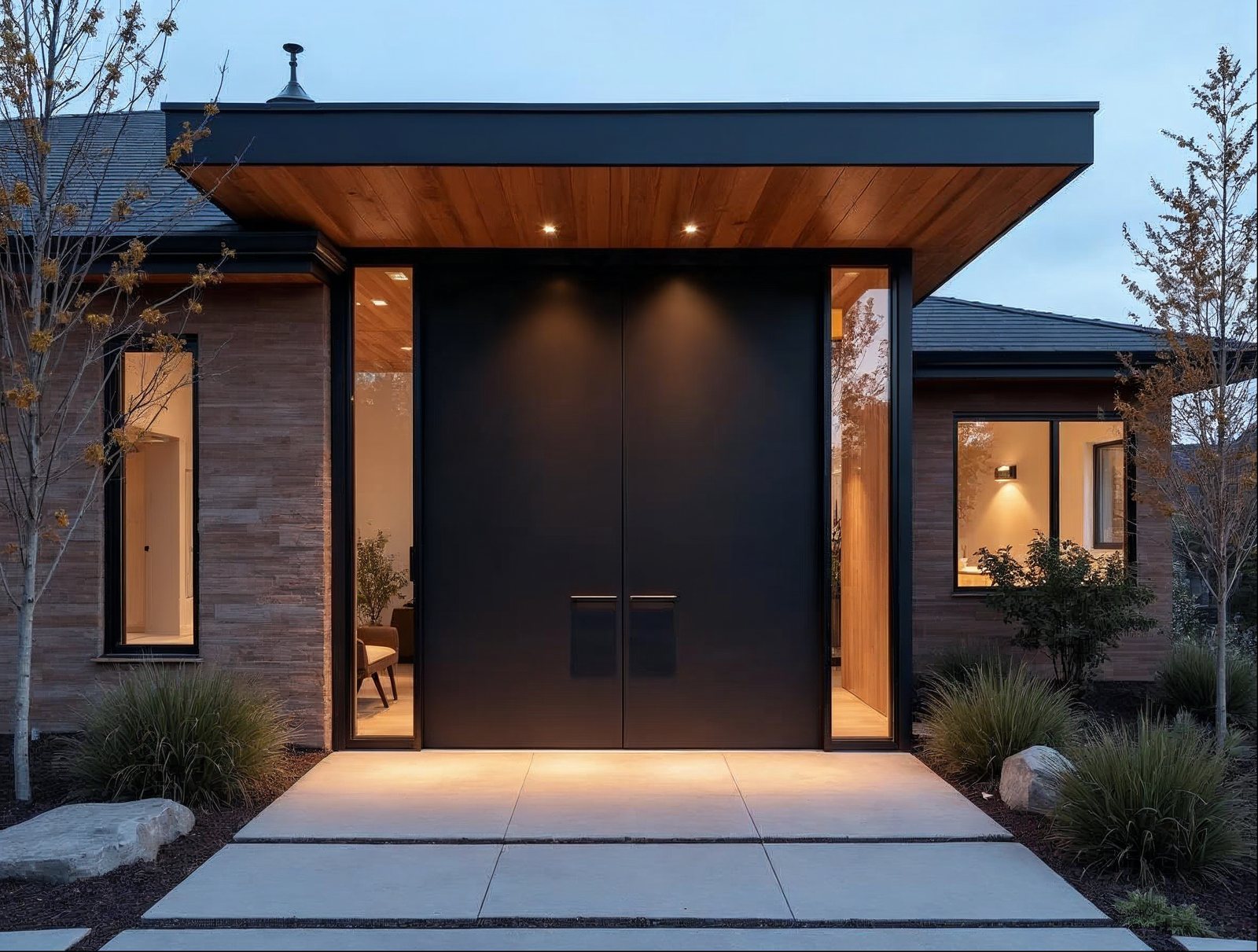
Oversized aluminum pivot front doors are increasingly specified on custom homes, luxury multifamily buildings, and commercial lobbies — and for good reason. A single slab rotating on a central pivot pin creates a monumental entry that no conventional swing door can replicate at scale. But the category carries real fabrication complexity: slab weight, structural header loads, hardware torque ratings, and rough-opening tolerances are all meaningfully different from a standard 3-0 × 6-8 entry door. This guide answers every dimension, cost, and construction question that contractors, builders, architects, and trade buyers ask before specifying one.
What dimensions are available for oversized aluminum pivot front doors?
Oversized aluminum pivot doors are available from roughly 3 ft wide × 8 ft tall up to approximately 5 ft wide × 12 ft tall as single-slab configurations, with custom fabrication pushing beyond those limits for bespoke projects. Standard pivot door widths run 36 in, 42 in, 48 in, and 60 in; standard heights are 84 in, 96 in, 108 in, and 144 in. Beyond those benchmarks, dimensions are made-to-order against your rough-opening spec.
A few dimensional realities builders must plan for:
- Slab width vs. clear opening: Because a pivot door rotates on a floor-and-ceiling (or floor-and-header) pin set inboard of the slab edge, the clear passage width is not the same as the slab width. On a 48-in slab with a pivot offset of 6–8 in from the leading edge, net clear width is roughly 40–42 in. Factor this into ADA path-of-travel planning early.
- Slab height maximums: Aluminum pivot slabs up to 10 ft tall are well within proven hardware limits. Slabs from 10–12 ft are achievable but require upgraded pivot sets rated for the additional moment load. Slabs above 12 ft should be evaluated case-by-case with a structural engineer.
- Panel thickness: Gladiator pivot doors use thermally broken aluminum frames with 6 mm tempered glass standard. Full slab thickness (frame + glass unit) typically runs 2¼ in to 3 in depending on configuration — different from a standard 1¾ in door, which matters for threshold and trim detailing.
- Sidelites and transoms: Many oversized pivot entries are framed with fixed glass sidelites (10–18 in) and/or clerestory transoms to amplify the monumental look without widening the pivot slab itself. These are factory-coordinated and ship as a matched system.
Browse Gladiator's full aluminum pivot door collection to see available size configurations and standard vs. custom-order breakpoints.
How much do large pivot doors cost compared to standard entry door systems?
Oversized aluminum pivot doors carry a significant premium over conventional entry doors, primarily because of slab mass, precision hardware, and thermal-break aluminum fabrication — but factory-direct ordering eliminates the dealer markup that inflates most high-end door prices. Here is how the categories stack up at a glance:
| Factor | Gladiator Oversized Aluminum Pivot | Traditional Swing Entry (Aluminum or Steel) | Wood-Clad Pivot Systems |
|---|---|---|---|
| Typical door-only price range | Factory-direct; call or apply for trade pricing | Lower upfront; often requires dealer surcharge | Highest; premium material + dealer network markup |
| Glass standard | 6 mm tempered, dual pane | Varies; often 3–4 mm standard | Varies by species/clad combo |
| Frame system | Thermal-break aluminum | Aluminum, steel, or fiberglass; not always thermally broken | Wood core + aluminum or composite cladding |
| Pivot hardware included | Yes — pivot set, bar handle, multi-point lock | N/A (swing hinge); hardware often extra | Sometimes; often separately sourced |
| Upcharge for large sizes | Transparent, no hidden surcharges | Low for standard sizes; steep for custom | High; custom wood-clad = highest cost tier |
| Shipping | Free nationwide | Varies by channel | Varies; freight can be significant |
| Warranty | 15 years | Typically 1–10 years, varies widely | Typically 1–5 years on wood components |
Key cost drivers to communicate to clients:
- Slab size: Width and height are the single biggest cost levers. A 48 × 108 in slab costs meaningfully more than a 36 × 96 in slab due to material and hardware weight-rating differences.
- Glass package: Low-E coatings, argon fills, and laminated options add cost but improve thermal performance — especially relevant on large-glass-area pivot entries for California Title 24 compliance.
- Sidelite/transom scope: Coordinated fixed glass panels add fabrication time and material but are priced as a unit system, often more economically than sourcing separately.
- Factory-direct vs. dealer channel: Gladiator sells direct to trade at wholesale pricing. There is no distributor taking a margin between our order desk and your project. For volume builders and developers, this difference compounds quickly across a project.
Trade and wholesale buyers should apply for a Reseller & Wholesale Account to access project pricing, volume discounts, and a dedicated account contact.
Are oversized pivot doors more expensive to fabricate and install than conventional doors?
Yes — both fabrication and installation costs are higher for oversized pivot doors than for conventional swing or sliding entries, and understanding why helps you budget and schedule accurately. The good news is that most of the complexity is in the hardware and rough opening, not in finish carpentry, which is typically simpler on a pivot than on a multi-panel hinged or folding system.
Fabrication complexity
- Thermally broken aluminum extrusions for a 10-ft slab must maintain precise tolerances across a longer run than a standard door — this demands tighter quality control and adds fabrication time.
- Glazing a 6 mm tempered dual-pane unit into an oversized slab requires specialized equipment and careful balancing to prevent racking during cure.
- Pivot-specific frame reinforcement (internal steel or aluminum stiffeners) adds weight and material cost but is non-negotiable for slabs above roughly 7 ft tall.
Installation complexity and labor
- Slab weight: A fully glazed aluminum pivot slab at 48 × 108 in can weigh 250–400 lbs depending on glass package. That requires a minimum two-person set crew, and often a mechanical lift assist for slabs above 10 ft.
- Pivot pin precision: Floor pivot cups must be set dead-plumb and at exact coordinates relative to the header pivot receiver — a tolerance error of even ¼ in causes binding or premature hardware wear.
- Structural header: See the rough-opening section below. This is where most builder surprises originate.
- Threshold detailing: A pivot door's threshold must handle both the rotating edge sweep and weatherstripping compression simultaneously. Low-profile threshold systems require precise sub-floor prep.
Compare this to Gladiator's aluminum bi-fold door systems, which distribute weight across multiple hinges and a track, or to sliding glass door systems, where installation complexity centers on track level rather than pivot-pin placement. Each system has its own set of trade-specific installation skills; pivot doors reward crews who have done at least one before.

What hardware — pivots, handles, and locking systems — is required for a large pivot door?
A large aluminum pivot door requires three distinct hardware systems working in coordination: the pivot mechanism itself, the pull handle, and the locking/latching system. Each is specified differently than conventional door hardware.
Pivot mechanisms
Pivot doors rotate on a floor-mounted pivot cup and an overhead pivot receiver. For slabs up to roughly 150 lbs, standard pivot sets are adequate. Slabs from 150–400 lbs require heavy-duty pivot sets with roller-bearing assemblies to maintain smooth operation over time. At the top end (400+ lbs), hydraulic floor closers integrated into the pivot function provide both weight support and controlled close speed — these are strongly recommended for any slab taller than 9 ft.
- Offset: Standard pivot offset is 4–8 in from the leading (lock) edge. A larger offset (toward center of the slab) makes the door feel lighter to open but reduces the net clear width of the opening.
- Soft-close / hold-open: Hydraulic pivot sets can be tuned for speed and hold-open angles. Specify this during the order process — it cannot be easily retrofitted.
Handles
Oversized pivot doors pair best with long-pull bar handles — typically 24 in to 48 in stainless steel or aluminum bars. The handle length should scale to the slab height. A 10-ft slab with a 12-in handle looks undersized and creates ergonomic issues. Gladiator pivot systems ship with coordinated handle sets; custom handle specifications are available at time of order.
Locking systems
Heavy pivot slabs require multi-point locking systems rather than a single-point deadbolt. Multi-point systems engage at three or more points along the lock edge of the slab simultaneously, distributing clamping force across the full slab height. This matters structurally: a single-point lock on a 400-lb slab creates a fulcrum effect that can warp the slab over time. Electronic access control (keypad, fob, or smart-lock actuators) can be integrated into the multi-point system — coordinate electrical rough-in before the door ships.
What construction details and rough opening specs do builders need for an oversized pivot door installation?
The rough opening and structural header are the most critical — and most commonly underspecified — elements of a successful oversized pivot door installation. Getting these right before the door ships saves significant time and cost on-site.
Rough opening sizing
General rule: rough opening width = slab width + 2 in; rough opening height = slab height + 2 in. These are starting points — always verify against the shop drawings provided with your Gladiator order. For pivot doors with sidelites, the rough opening must accommodate the full framed unit width, including sidelite frames and any required expansion gaps at masonry or structural openings.
Structural header requirements
This is where most builders encounter surprises. A pivot door does not carry load through a continuous frame the way a hinged door does — the entire slab weight transfers through two hardware points (floor pivot cup and header receiver). The header must be engineered to handle the point-load concentration at the top pivot pin location. For openings exceeding 6 ft wide at any floor level above grade, a structural engineer should confirm header sizing before framing begins. Standard LVL headers sized for a conventional door opening will often be undersized for an 8–12 ft oversized pivot.
Floor flatness and substrate
- Floor pivot cups are typically mortised into a floor plate or set on a surface-mount base. Either way, the floor within 12 in of the pivot cup location must be flat to within ⅛ in over 24 in — standard concrete tolerance is not always sufficient without grinding.
- For wood-frame floors, solid blocking must be installed between joists directly below the floor pivot location to handle the vertical point load.
Wall thickness and reveal
Oversized pivot frames are typically 3–4 in deep. In a standard 2×6 exterior wall with sheathing and interior drywall, the total wall assembly is roughly 7–7½ in. Confirm frame depth against your wall section before ordering — a mismatch creates reveal and trim detailing problems that are expensive to fix after installation.
Threshold and waterproofing
Pivot doors require a continuous threshold with an integrated drain or slope-away detail on the exterior. The floor pivot cup must be positioned away from water migration paths. For slab-on-grade or recessed threshold details, coordinate waterproofing membrane termination points with the door supplier before rough-in.
For related planning resources, see our guide on folding passthrough windows (useful when a pivot entry is specified alongside a kitchen or bar passthrough on the same project) and check in-stock doors ready to ship for projects with tight schedules.
How long does it take to fabricate and deliver a large custom aluminum pivot door?
Lead times for oversized aluminum pivot doors depend on whether the door falls within a standard size range or requires full custom fabrication. Standard configurations held in inventory can ship within days; large custom-fabricated slabs typically require 8–14 weeks from order confirmation to freight delivery, with 10–12 weeks being the most common range for a 48 × 108 in or similar custom pivot.
Lead time breakdown by order type
- In-stock standard sizes (up to ~48 × 96 in): Ships within 1–2 weeks. Check current in-stock inventory for available configurations and lead times.
- Made-to-order custom sizes: 8–14 weeks depending on slab dimensions, glass package, and hardware configuration. Order confirmation triggers shop drawing production; builder/architect approval of shop drawings is required before fabrication begins — factor 1–2 weeks for drawing review into your schedule.
- Projects with sidelites and transoms: Same lead time as the door slab; all components fabricate and ship together as one coordinated unit.
Ordering process for trade buyers
- Submit rough opening dimensions and project specs to your Gladiator trade account contact.
- Receive a quote with itemized options (glass package, hardware, finish).
- Approve shop drawings — these confirm slab dimensions, pivot offset, hardware placement, and threshold details before fabrication locks in.
- Production begins upon drawing approval and deposit.
- Freight delivery is coordinated with your site schedule; Gladiator ships free to all 50 states.
The shop-drawing approval step is non-negotiable on custom orders and is the single most common source of schedule slippage — budget time for it and loop in your structural team before sign-off. For volume developers or resellers with recurring pivot door specifications, a wholesale account locks in trade pricing and streamlines the quote-to-order cycle on every project.
Apply for a Reseller & Wholesale Account to access trade pricing, project quoting, and a dedicated account manager for your pipeline.
Article by the Gladiator Window & Doors technical team — factory-direct aluminum door specialists serving contractors, builders, architects, and trade buyers across all 50 states.
Sell Gladiator doors at a wholesale price. Factory-direct aluminum sliding, bi-fold, and pivot doors — premium aluminum, 6mm glass, low-profile tracks, no upcharges, shipped nationwide. Contractors, builders, designers, and retailers get trade pricing and real support.
Apply for a Reseller & Wholesale Account · Call 904-822-1078


